
Principles to contamination class
Read the draft explanation
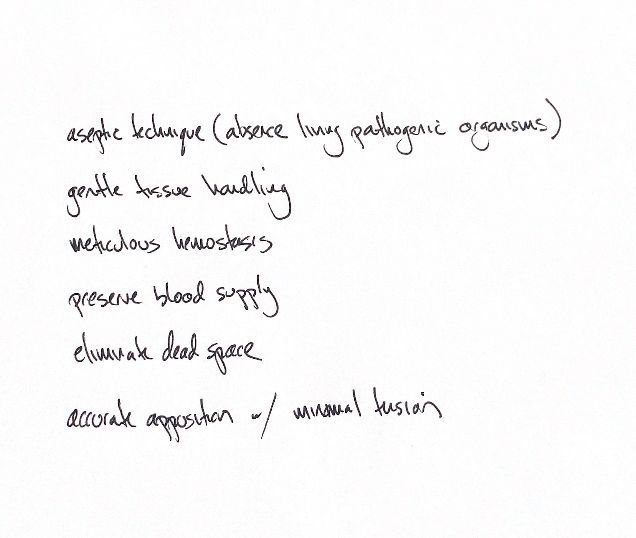
Good surgical technique protects living tissue. Keep pathogens out, handle tissue gently and control bleeding carefully. Preserve the blood supply, remove dead space, and bring tissue edges together accurately with little tension. These are Halsted’s six principles.
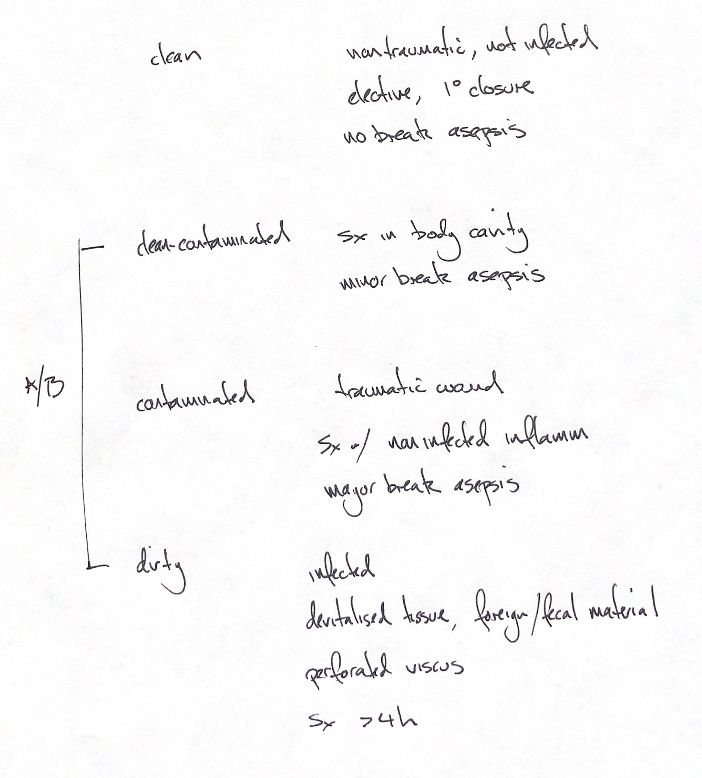
Next, assess the wound class. A clean wound is nontraumatic and uninfected, with no inflammation or break in aseptic technique. In the traditional scheme, it is an elective primary closure without a drain.
Clean-contaminated includes controlled entry into a hollow viscus and minor breaks in aseptic technique. Opening a sterile body cavity alone can still be clean. The important difference is entry into a colonised lumen.
Contaminated includes fresh open traumatic wounds, acute inflammation without pus, and major breaks in aseptic technique.
Dirty includes existing infection or pus, a perforated viscus, and traumatic wounds with dead tissue, foreign material or faecal contamination. The traditional table also lists traumatic wounds more than 4 hours old. That is injury age, not the length of the operation. Tissue viability and infection findings still guide assessment.
Antimicrobials are commonly considered for clean-contaminated, contaminated and dirty wounds. Existing infection needs treatment. Some clean procedures, such as implant surgery, may also warrant prophylaxis because infection would have serious consequences. Use the class alongside patient and procedure risks.
References
Chris Wood’s surgical study notes; Johnston & Tobias, Veterinary Surgery: Small Animal, 2nd ed., Box 17.1 and Ch10, Table 10.6 and perioperative antimicrobial section. The four-hour entry is from the traditional human wound-classification scheme reproduced there.