
Pressure-sore grades and source treatment options
Read the draft explanation
For a pressure sore, first ask how deep the damage goes.
This is the older veterinary grading scheme from Swaim, Hanson and Coates (1997, after Swaim & Henderson 1990). It differs from current human pressure-injury staging.
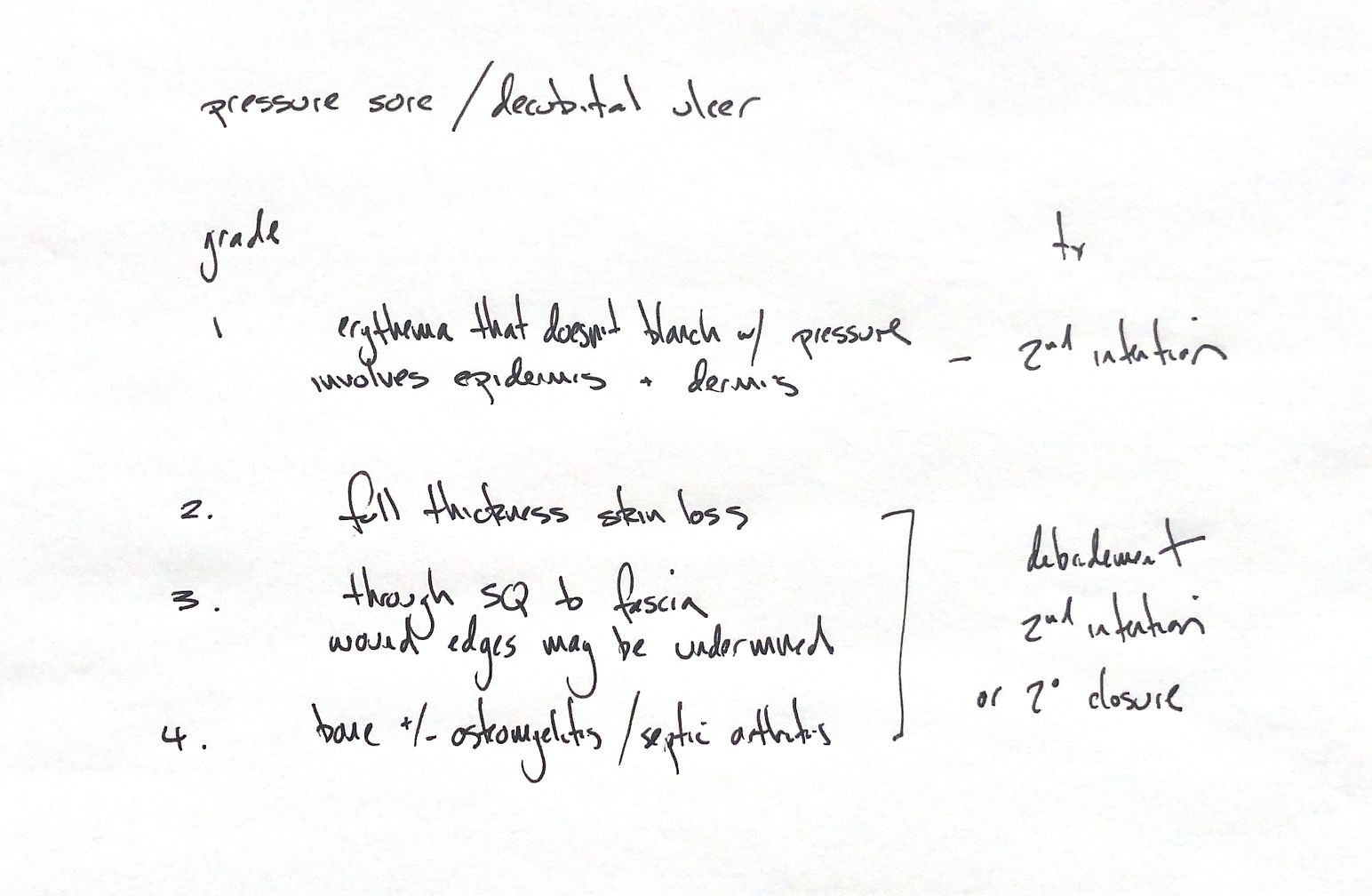
Grade I starts with non-blanching erythema: redness that does not fade under pressure. The epidermis and upper dermis may slough.
Grade II is full-thickness skin loss down to the subcutis. Grade III passes through the subcutis to deep fascia; the edges may be undermined. Grade IV reaches bone. Osteomyelitis or septic arthritis may also develop.
Treatment depends on the wound. Grade I surface loss receives wound care and may heal by second intention. Second intention describes an open surface wound. It does not mean creating an ulcer in intact red skin.
Grades II–IV need debridement. Once there is a healthy wound bed, options include second-intention healing or secondary closure. Closure depends on the wound's condition and may need to wait. In every grade, take pressure off the affected area.
Redrawn from my original surgical study notes. Classification/treatment: Swaim SF, Hanson RR Jr, Coates JR. Decubitus Ulcers in Animals. The Decubitus Ulcer in Clinical Practice. Springer, 1997:217–238. https://doi.org/10.1007/978-3-642-60509-3_20. Depth definitions: Mauldin EA, Peters-Kennedy J. Integumentary System. Jubb, Kennedy & Palmer's Pathology of Domestic Animals, Vol.1, 2016:509–736.e1, https://pmc.ncbi.nlm.nih.gov/articles/PMC7810815/.