
JP grenade suction and Poiseuille flow
Read the draft explanation
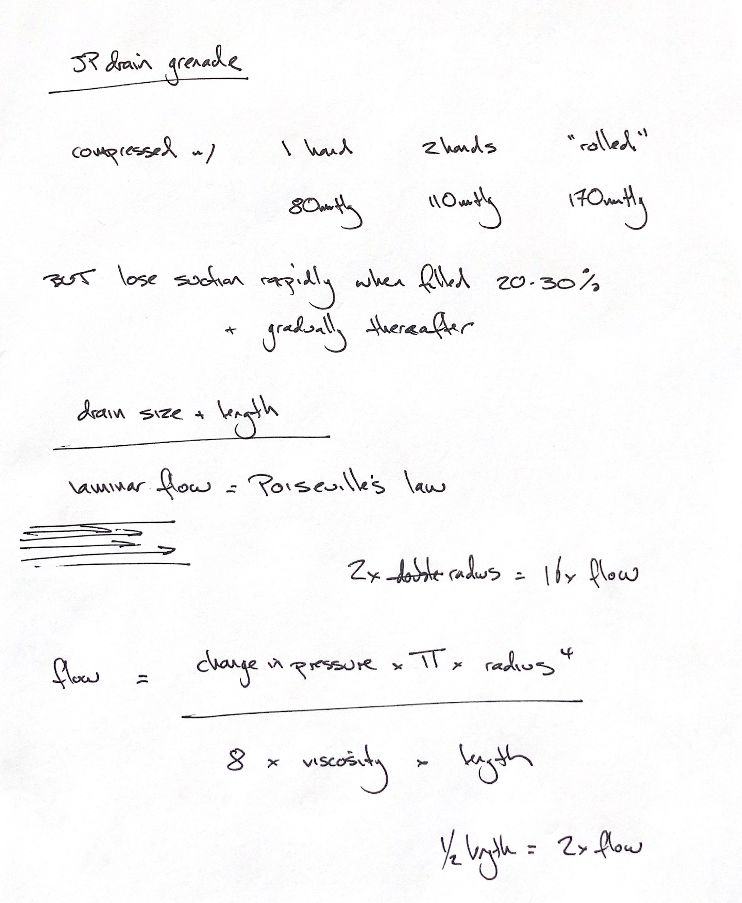
How you compress a JP grenade changes the suction it creates.
In-vitro suction magnitudes were approximately 84 mmHg with one hand, 110 mmHg with two hands and 170 mmHg when rolling the reservoir from apex to base. These are magnitudes of negative pressure. The one-hand measurement is approximately 84 mmHg, or roughly 80 mmHg when rounded. Suction varies with the device and compression method.
Halfacree and colleagues tested 11 drain systems, including two grenade-type reservoirs. In compressible reservoirs, suction fell quickly as filling reached 20–30%, then declined more gradually. Performance varied among devices.
Flow through the tube follows a separate principle. In the ideal model, Poiseuille's law is Q = ΔPπr⁴/(8ηL). Q is flow rate. ΔP is the pressure difference between the tube ends. The other terms are internal radius, r; fluid viscosity, η; and tube length, L.
Keep everything else the same and double the radius: flow rises 16-fold. Halve the length: flow doubles. Thicker, more viscous fluid flows more slowly. A larger pressure difference increases flow. This model assumes steady laminar flow of a Newtonian fluid through a rigid cylindrical tube.
References
Campbell, Bandages and Drains, Johnston & Tobias, Veterinary Surgery: Small Animal, 2nd ed., ch.19 (the three pressure values; reservoir-specific averaging conditions are not given). Device/compression/filling findings: Halfacree ZJ, Wilson AM, Baines SJ. Evaluation of in vitro performance of suction drains. Am J Vet Res 2009;70:283–289. DOI 10.2460/ajvr.70.2.283, https://pubmed.ncbi.nlm.nih.gov/19231963/. The abstract supports the device and filling findings, but does not report the pressure triplet.