
Laplace pressure and recognition of a tight bandage
Read the draft explanation
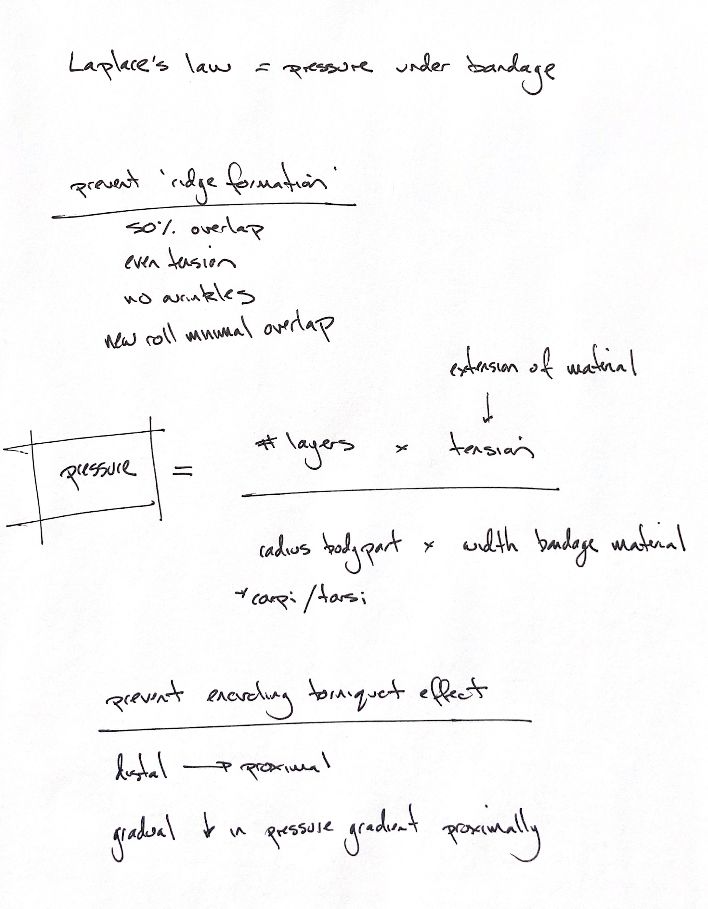
Bandage pressure depends on how you wrap the limb and on the shape beneath it.
For an ideal cylinder, P ∝ nT/(rw). More layers or more tension raise pressure. A larger radius or wider bandage lowers it, with everything else unchanged. Stretching the material changes tension. Narrow areas just above the digits, carpus and tarsus need extra care.
Keep tension even, avoid wrinkles and use 50% overlap. Start each new roll with minimal overlap of the previous roll's end, then keep the half-width pattern. The wrapping sequence shown runs distal to proximal, proximal to distal, then distal to proximal, ending proximally. Pressure should decrease proximally, but narrow areas can disrupt that gradient.
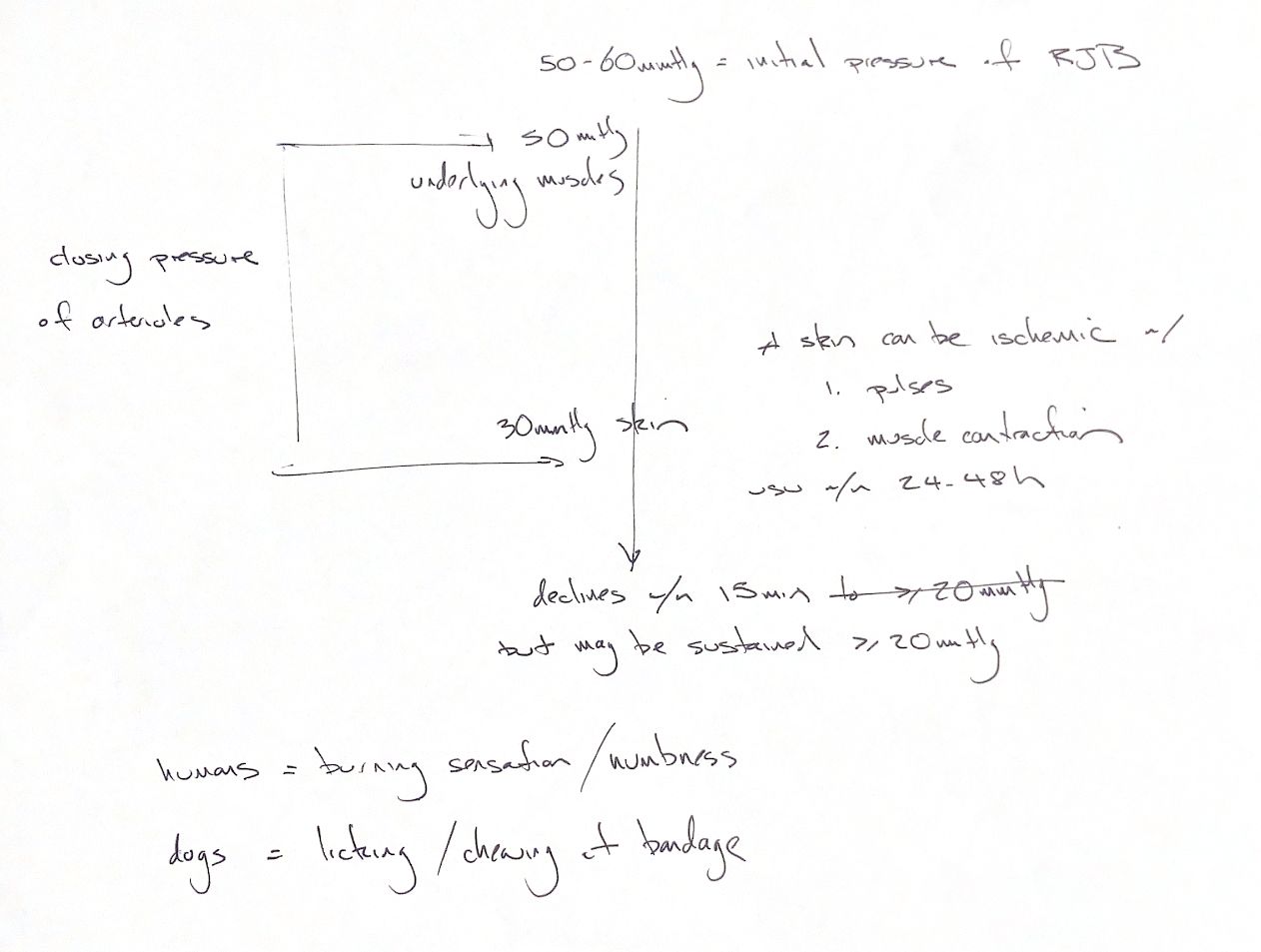
Approximate experimental arteriolar closing pressures are 30 mmHg in skin and 50 mmHg in muscle. These describe vessel closure, not safe pressures to aim for. Skin can become ischaemic while a peripheral pulse and muscle contraction remain.
Robert Jones bandages can start at 50–60 mmHg, with pressure falling in the first 15 minutes. In people, pressure may remain at 20 mmHg or greater. The handwritten “≫20” is corrected here to “20 mmHg or greater”. These measurements describe bandage behaviour rather than an application target.
People describe burning or numbness under a tight bandage. Dogs may respond to a similar sensation by licking or chewing. Most reported ischaemic bandage injuries occurred in the 24–48-hour window. This supports routine rechecks in that period. Injury can develop sooner. If there is concern, remove the whole bandage and assess the tissues earlier.
References
Campbell, Bandages and Drains, Johnston & Tobias, Veterinary Surgery: Small Animal, 2nd ed., ch.19. Experimental reference: Ogata & Whiteside, Clin Orthop Relat Res 1982;(168):105–107, https://pubmed.ncbi.nlm.nih.gov/7105530/. Injury series: Anderson & White, Vet Surg 2000;29:488–498, https://pubmed.ncbi.nlm.nih.gov/11098781/.