
Local and systemic factors
Read the draft explanation
Why do some wounds heal slowly? Start with oxygen, tissue health and tension.
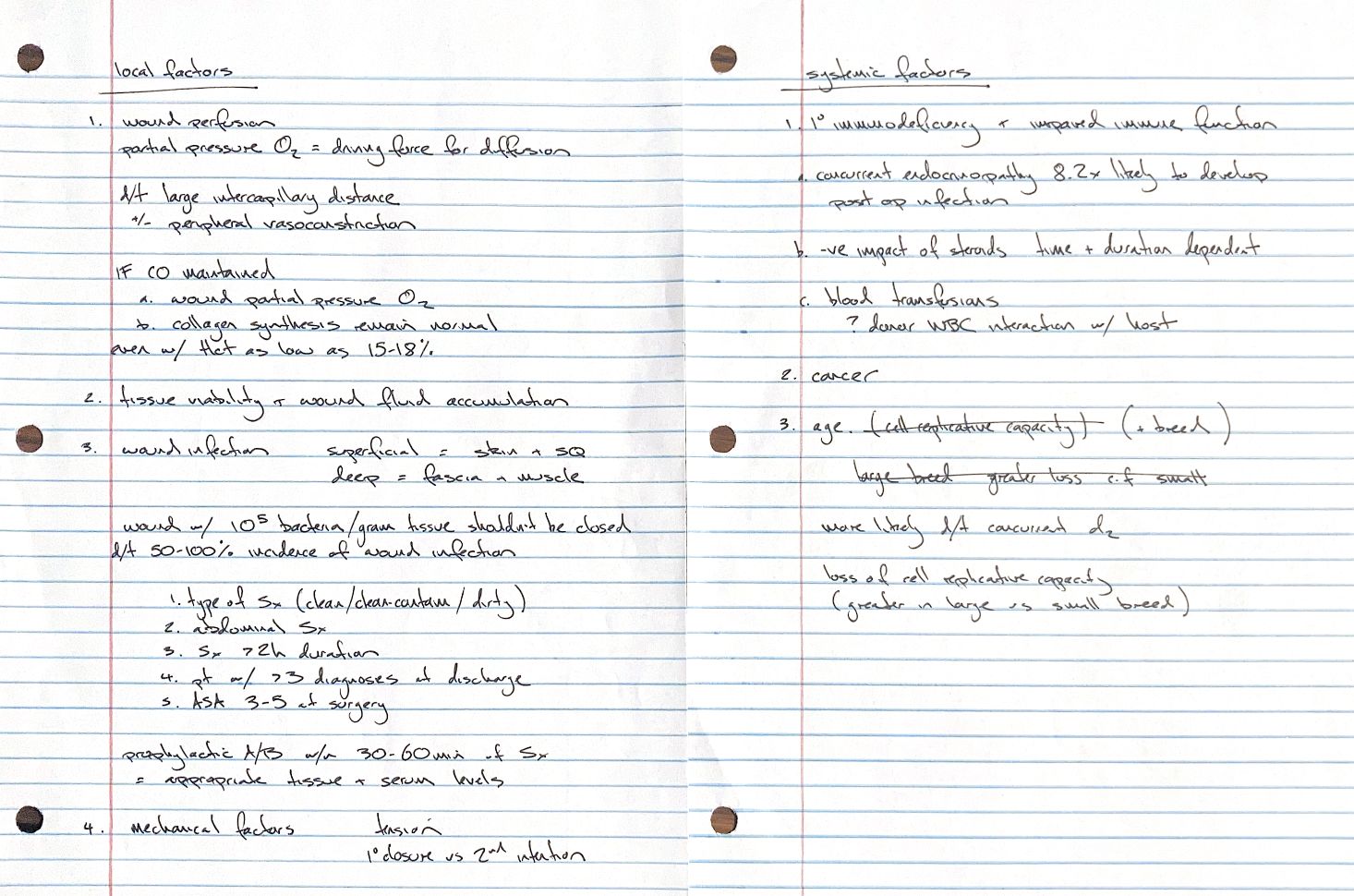
Local PO₂ drives oxygen diffusion. Wider gaps between capillaries and vasoconstriction reduce delivery. In human anaemia studies, wound PO₂ and collagen synthesis were preserved at Hct 15–18% when cardiac output was maintained. These human findings do not set a veterinary transfusion threshold.
Dead tissue prolongs inflammation. Dead space and fluid matter too: fluid separates tissues, raises pressure and supports bacteria. Excess tension impairs repair. Primary closure and second intention also follow different paths.
Superficial incisional SSI affects skin and subcutis; deep SSI affects fascia and muscle. Historical human guidance linked closure of open traumatic wounds with >10⁵ bacteria/g tissue to 50–100% infection. That is a human association, not a dog or cat prediction. Tissue preparation, debridement and lavage remain part of the closure assessment.
Two human risk systems appear in the notes. SENIC uses ≥3 discharge diagnoses, correcting the handwritten >3, and an operation lasting >2 hours. NNIS uses procedure-specific time T and ASA 3–5. Wound classes describe categories, not stages a wound must pass through. When prophylaxis is indicated, giving it 30–60 minutes before incision allows serum and tissue levels to build.
In a 239-dog/cat clean-contaminated cohort, patients with endocrinopathy were reportedly 8.2× as likely to develop postoperative wound infection. No animal in the cohort had diabetes. This is a cohort association. Steroid effects depend on timing, dose and duration. Proposed transfusion effects involve donor-leukocyte/host interactions and reduced IL-2.
Cancer and its treatment can impair repair. Age, other disease and dermal-cell capacity also matter. The breed-size comparison measured canine fibroblast division in vitro, rather than healing speed in patients.
References
Johnston & Tobias, Veterinary Surgery: Small Animal, 2nd ed., chs. 9, 10, 79; Nicholson et al. 2002, doi:10.1053/jvet.2002.34661; SENIC/NNIS: Haley 1985, doi:10.1093/oxfordjournals.aje.a113991; Culver 1991, doi:10.1016/0002-9343(91)90361-Z. Redrawn from my surgical study notes.