
Intrinsic laryngeal innervation
Read the draft explanation
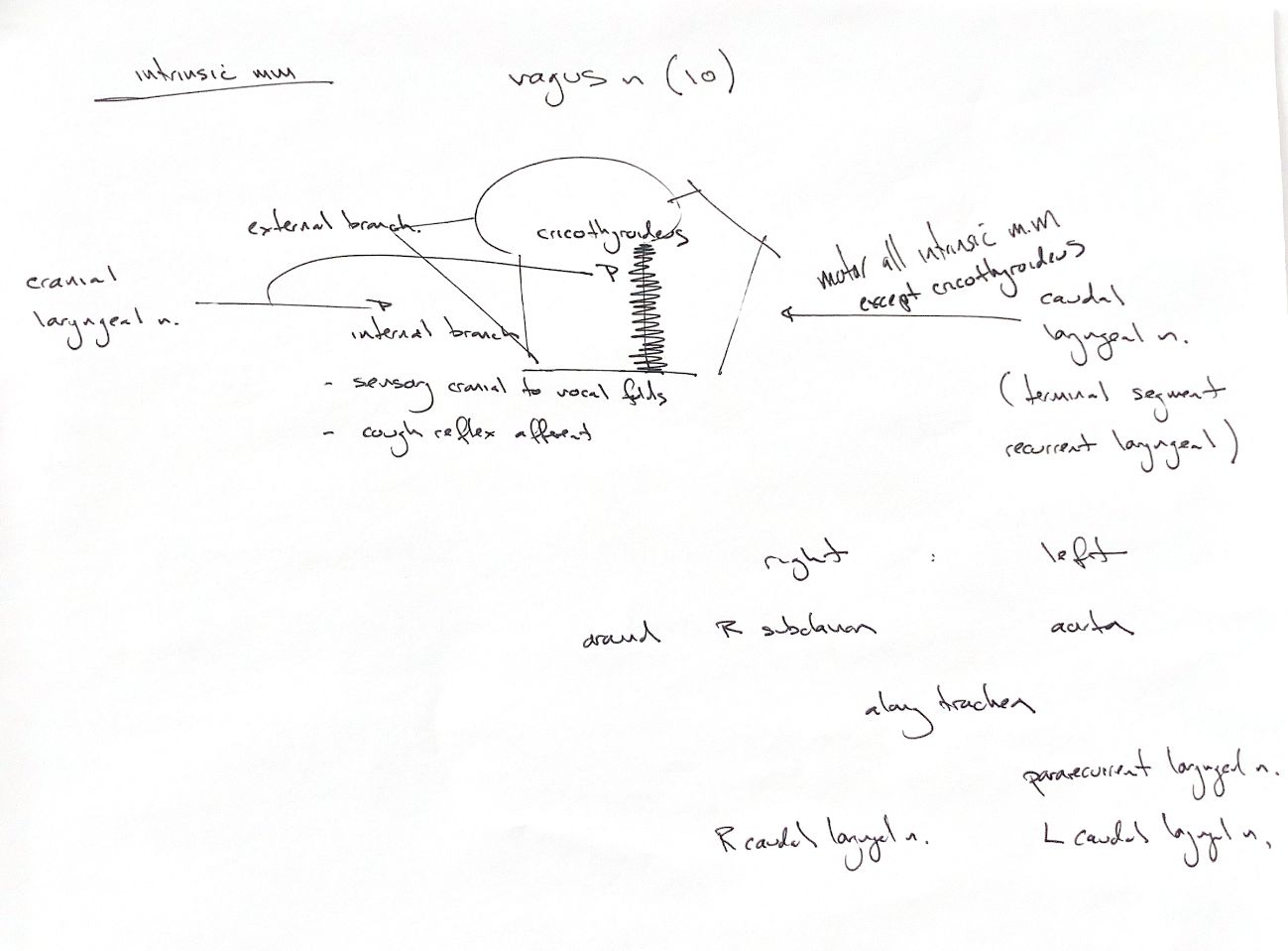
The main laryngeal branches arise from the vagus nerve, cranial nerve X. The cranial laryngeal nerve divides into external and internal branches. The external branch supplies cricothyroideus. The internal branch carries sensory information from mucosa cranial to the vocal folds and forms an afferent limb of the cough reflex.
The caudal laryngeal nerve is the terminal segment of the recurrent laryngeal nerve. The note and textbook use the reminder “motor to all intrinsic laryngeal muscles except cricothyroideus.” Its scope matters: hyoepiglotticus is supplied by the hypoglossal nerve, cranial nerve XII. The broad intrinsic-muscle wording should not assign that muscle to the vagus.
The lower word comparison records the recurrent courses. On the right, the nerve loops around the right subclavian artery; on the left, it arches around the aorta. Both ascend along the trachea. The left side gives off the pararecurrent laryngeal nerve before ending as the left caudal laryngeal nerve.
The typed recall asks which nerve supplies the laryngeal mucosa. Its broad cranial-laryngeal answer is refined by the drawing and textbook: the internal branch supplies the region cranial to the vocal folds. This is a regional sensory reminder, rather than a claim that one branch supplies every mucosal region.
The original sketch is a recall scheme. Its crossing annotation strokes do not define every anatomical branch or prove a direction of nerve signalling.
References
Johnston & Tobias, 2nd ed., Ch 101; Skerrett et al. 2015, selected discussion; Amis et al. 1996, abstracts.