
Gate-control theory
Read the draft explanation
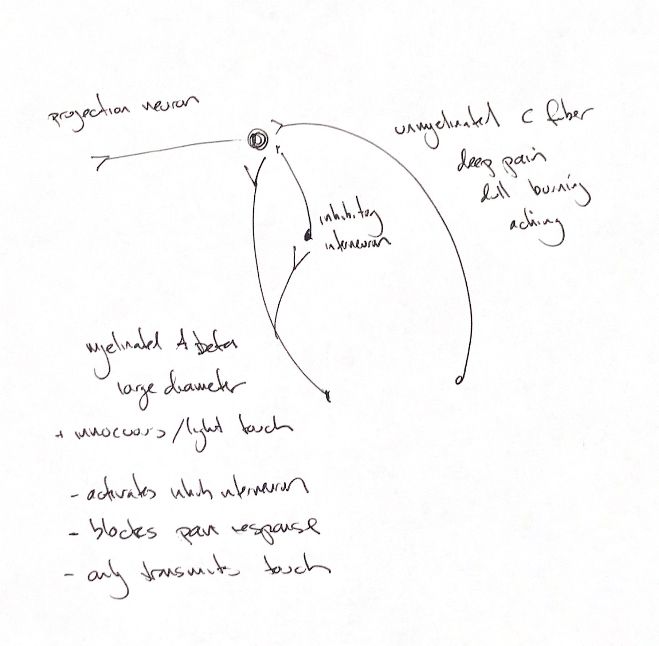
Gate-control theory explains how incoming sensory activity can be modified within the spinal dorsal horn before it contributes to ascending nociceptive signalling. The sketch contrasts a large, myelinated Aβ touch input with an unmyelinated C-fibre input and includes an inhibitory interneuron beside the projection neuron.
Aβ low-threshold mechanoreceptor activity can recruit inhibition and reduce nociceptive transmission. This is the useful idea behind the original “blocks pain response” and “only transmits touch” reminders. They describe a simplified gating effect, rather than a guarantee that pain is abolished whenever touch is present. Large-fibre input can also excite spinal circuits; its net effect depends on the circuit and conditions.
The C-fibre side recalls slower, dull, burning or aching sensations. “Deep pain” is the original descriptor, not a test of deep nociception and not the only function of every C fibre.
Experimental mouse work identifies inhibitory circuits that restrict Aβ access to mechanical-pain pathways. After nerve injury, inflammation or loss of inhibition, light-touch input can instead help drive mechanical allodynia: pain from a stimulus that would normally be innocuous. Cat dorsal-horn recordings also show that vibration responses vary with the neuron and stimulation site. These experiments do not establish a guaranteed analgesic effect in an individual dog or cat.
The drawing is a compact circuit reminder. Nociceptive signalling and the experience of pain remain different concepts; a spinal circuit or withdrawal response alone cannot establish that experience.
References
Melzack & Wall 1965, selected original text; Duan et al. 2014; Cheng et al. 2017; Salter & Henry 1990, indexed abstracts; Johnston & Tobias, 2nd ed., Ch26, sensory context.