
TECA postoperative neurological complications
Read the draft explanation
TECA means total ear canal ablation. Check facial nerve function before surgery. Ear disease can already cause a drooping lip, an absent blink and a dropped ear on the affected side.
Damage to postganglionic sympathetic fibres in the middle ear can cause Horner’s syndrome. The eye sits farther back (enophthalmos), the third eyelid rises, the pupil narrows (miosis) and the upper eyelid droops (ptosis). Cats are affected more often than dogs in the reported series.
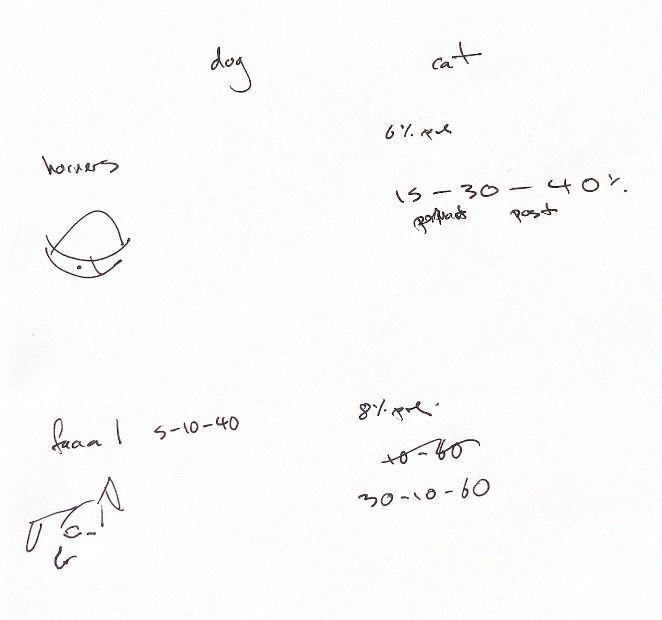
For cats, the supplied book reports Horner’s syndrome in 6% before surgery, 27–42% after TECA with bulla osteotomy, and permanent signs in 14–27%. My handwritten recall cue is 6% before surgery, 15–30% permanent and 40% after surgery. Those figures differ from the book's ranges.
For facial nerve dysfunction, the book reports 13–39% after surgery in dogs, with permanent deficits in 4–13%. In cats, it gives 8% before surgery, 12–56% after surgery and up to 28% permanently affected.
My facial-nerve strings are “5–10–40” for dogs and “30–10–60” for cats. Their outcome labels are missing, so I have kept them as unpartitioned study mnemonics. They cannot replace the labelled rates or be used to calculate a chance of recovery.
These are historical reports with different operations, populations and follow-up. New postoperative deficits must be separated from problems already present before surgery. The percentages do not come from one matched cohort. Exact eligible denominators were not recovered for every reported outcome.
References
Johnston & Tobias, 2nd ed., Ch122; Bacon2003; Williams & White1992; Guillaumot2011; Mason1988; Devitt1997.