
Malignant hyperthermia
Read the draft explanation
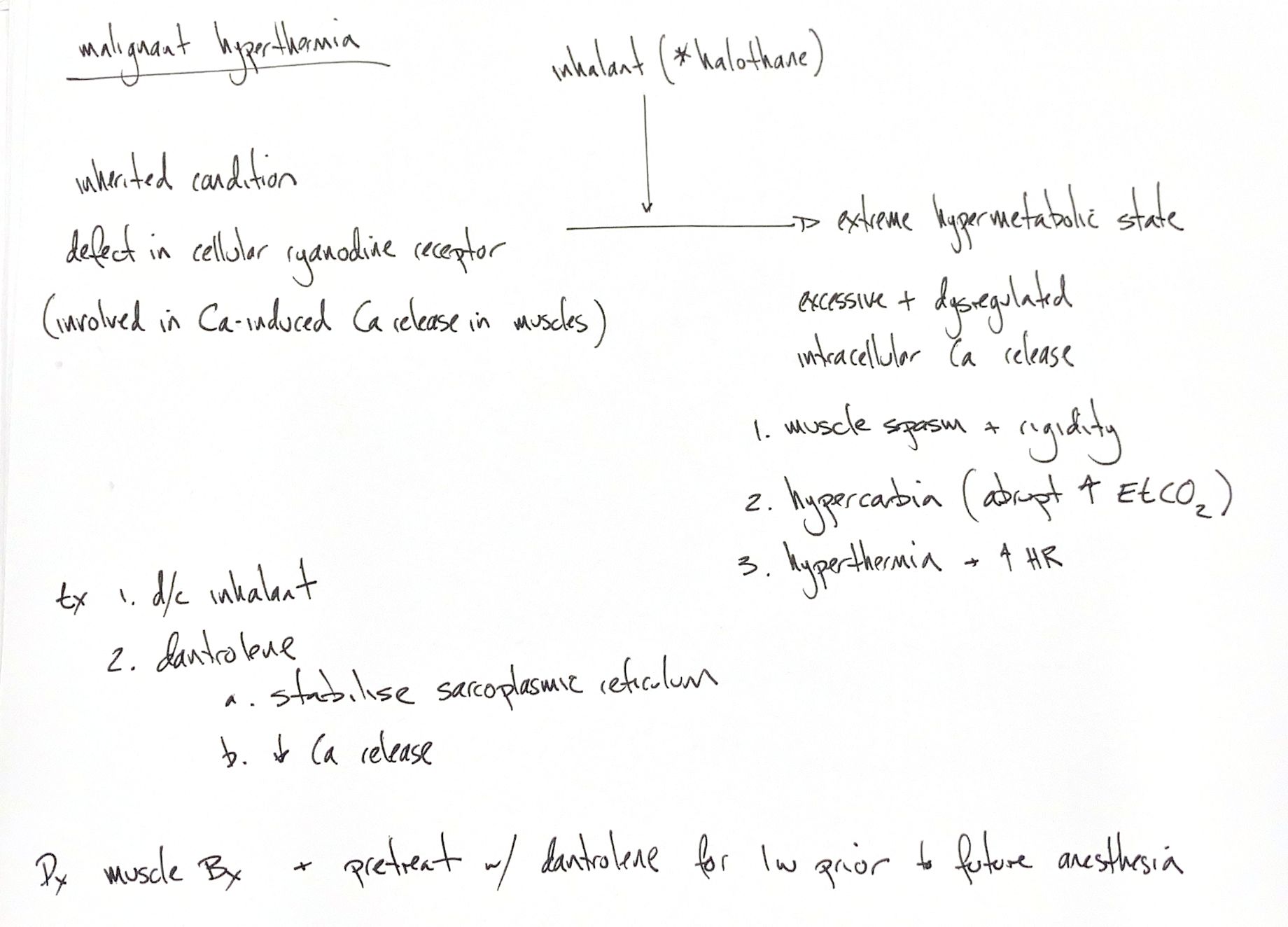
Malignant hyperthermia is a crisis of skeletal-muscle calcium control. My inherited-condition cue refers to genetic susceptibility involving the ryanodine receptor, RyR1. Canine susceptibility can be inherited, but a reported variant arose de novo, without being inherited from either parent.
The note calls the mechanism calcium-induced calcium release. The key problem is excessive, poorly controlled calcium release inside muscle. A trigger can produce an extreme hypermetabolic state, muscle spasm and rigidity. Halothane is starred in the note; it is not the only triggering inhalant. Isoflurane, sevoflurane and succinylcholine also matter.
An abrupt, unexplained rise in end-tidal CO2 can be an early warning, even with adequate ventilation. Temperature and heart rate may rise too. Signs vary, so a high temperature is not required before suspicion. Ventilation, circuit faults and other causes of hypercapnia still need assessment.
The treatment cues are to stop the triggering inhalant and give intravenous dantrolene. It reduces calcium release from the sarcoplasmic reticulum. Oxygenation, ventilation, cooling when needed and management of complications also matter. This is not a complete crisis protocol.
My muscle-biopsy cue refers to specialist contracture testing for susceptibility, not routine histology alone. Genetic testing needs interpretation too.
The original and book describe oral dantrolene for one week before future nonemergency anaesthesia. The exact canine preventive schedule was not verified. The book’s cited human review and current human EMHG guidance do not recommend routine pretreatment with trigger-free care. This difference does not turn human guidance into a veterinary prescription. Avoiding triggers and preparing the anaesthetic system remain central.
References
Johnston & Tobias, 2nd ed., Ch21–22; Nelson1991; Roberts2001; RYR1 canine reports2024–26; Rosenberg2007; EMHG; Merck Veterinary Manual.