
Monro–Kellie, CPP and cerebral haemodynamics
Read the draft explanation
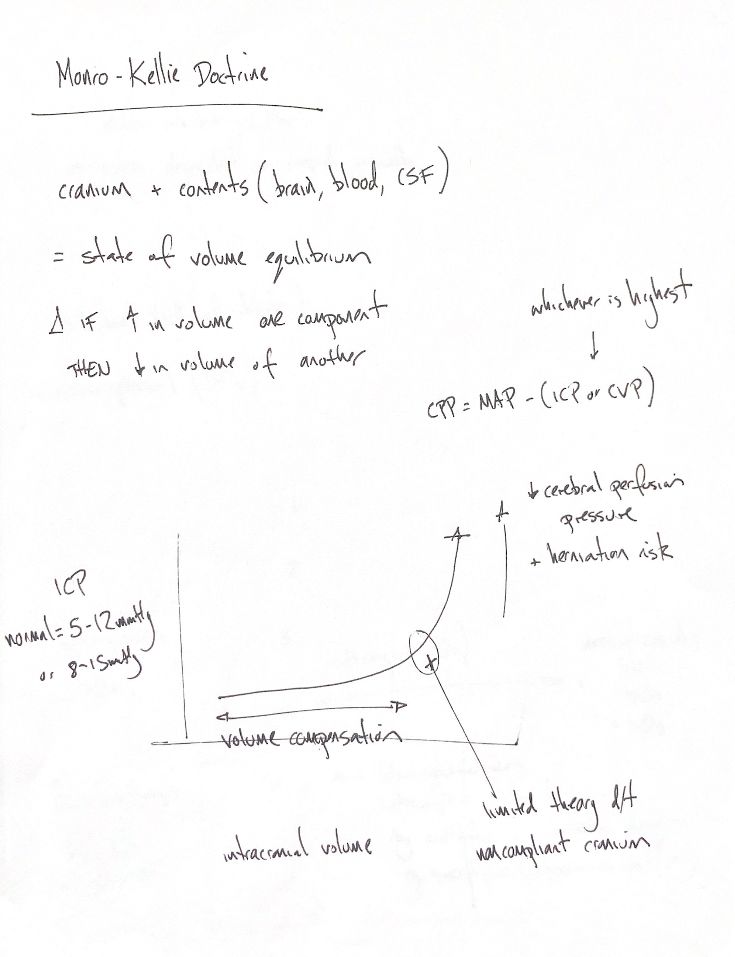
The skull contains brain, blood and cerebrospinal fluid. If one volume rises, another must fall. That reserve is limited. Once compensation runs out, a small extra volume can cause a steep rise in intracranial pressure (ICP), lower perfusion and raise herniation risk.
Cerebral perfusion pressure (CPP) is mean arterial pressure minus whichever is higher: ICP or central venous pressure. The ranges on the drawings are study references, rather than fixed targets for every patient. The note and textbook also give different autoregulation limits.
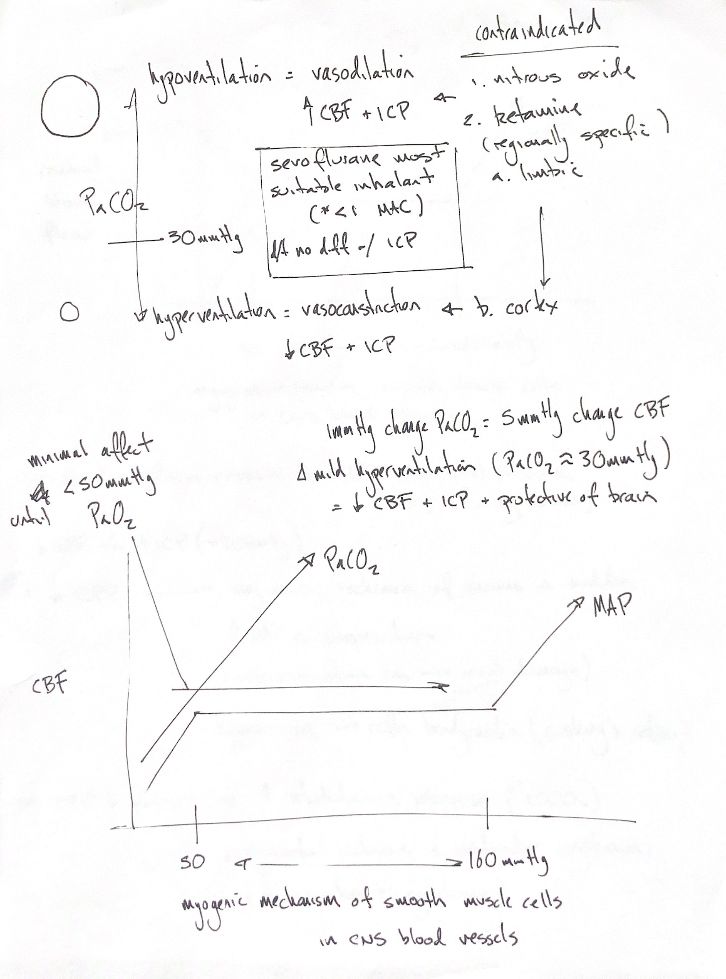
Rising arterial carbon dioxide (PaCO2) dilates cerebral vessels and can raise cerebral blood flow (CBF) and ICP. Lowering PaCO2 does the reverse. The source's “5 mmHg CBF” shorthand has incompatible flow units, so I do not use it as a numerical rule.
The note calls mild hyperventilation near PaCO2 30 mmHg protective. Lower ICP does not guarantee brain protection: reduced flow can also reduce oxygen delivery. The book gives both this target and a warning to reserve hypocapnia for life-threatening circumstances such as impending herniation. Human brain-injury guidance also warns against prolonged prophylactic hyperventilation.
The drug cues need context. Nitrous oxide can raise CBF and ICP. Ketamine's historical contraindication is qualified by ventilation, other drugs and limited canine/feline disease data. The book describes regional limbic and cortical effects. It commonly uses propofol for induction, while warning that falling blood pressure can lower CPP.
Sevoflurane is the note's preferred low-MAC inhalant. The supporting dog study used controlled ventilation and hypocapnia. Unchanged ICP did not prevent falling arterial pressure and CPP. No agent is universally pressure-neutral.
References
Johnston & Tobias, 2nd ed., Ch36; Takahashi1993; Schmidt2003/2008; Chohan2013; Marion2002; selected BTF guidance.