
Allergic airway disease
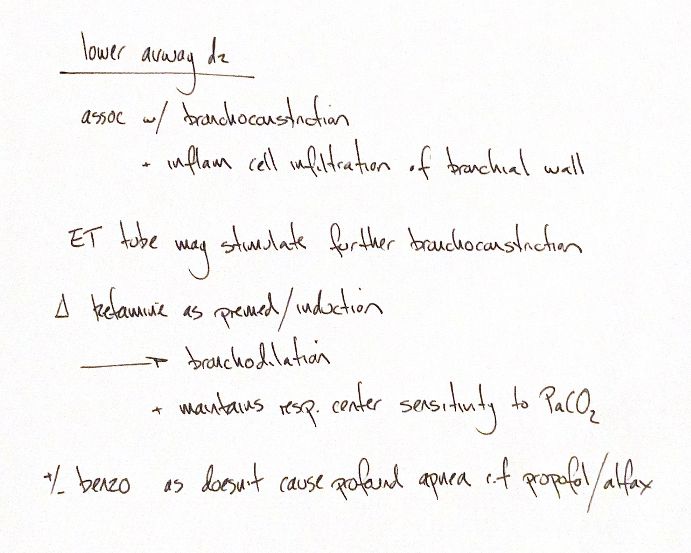
Read the draft explanation
Allergic lower airway disease can narrow the bronchi through bronchoconstriction and inflammatory cells in the bronchial wall. An endotracheal tube may trigger more bronchoconstriction in an already reactive airway.
The book describes ketamine as a useful part of premedication or induction because it can cause bronchodilation. It also describes a retained respiratory response to arterial carbon dioxide, PaCO2. This helps explain the choice, but it does not mean ventilation stays normal. In an experimental cat study, the response to inhaled CO2 was retained even though resting ventilation fell and CO2 rose. A pressure-based measure of inspiratory drive was still depressed.
My optional benzodiazepine note belongs with ketamine. The book contrasts this combination with the profound apnoea that can follow propofol or alfaxalone. That is a relative teaching cue, not a promise of uninterrupted breathing. A healthy-dog study found transient respiratory depression with ketamine–midazolam, with a greater effect after a bolus than an infusion.
Drug choice still depends on the patient and the full combination. Animals with respiratory disease need close observation for hypoventilation and hypoxaemia, with an airway and ventilation plan. These notes explain a rationale; they are not a fixed anaesthetic protocol.
References
Johnston & Tobias, 2nd ed., Chapter 22; Jaspar et al. 1983; Brown & Wagner 1999; Jacobson & Hartsfield 1993 (indexed abstracts).