
Benzodiazepines
Read the draft explanation
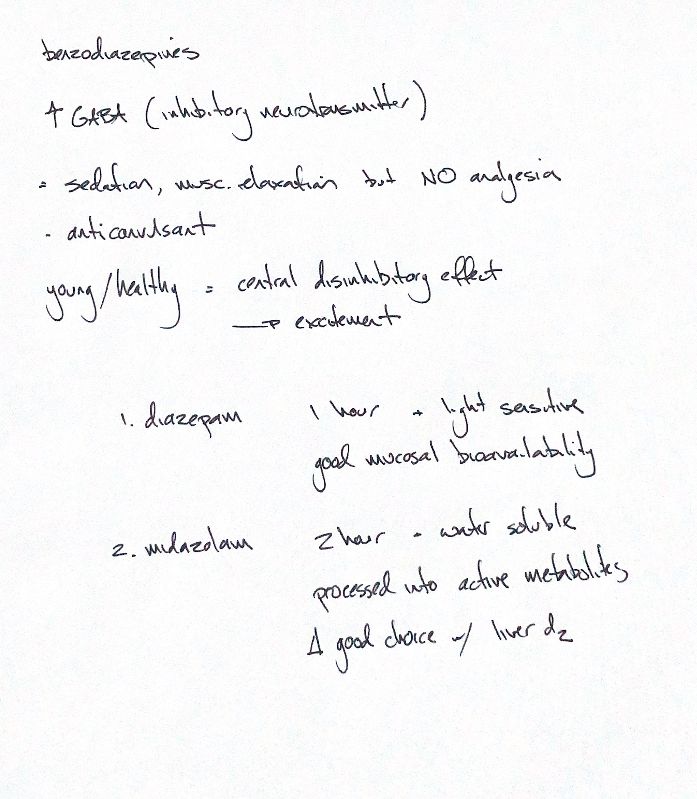
Benzodiazepines enhance the effects of GABA at GABA_A receptors. GABA is an inhibitory neurotransmitter. The upward GABA cue means stronger GABA-mediated inhibition, not more GABA synthesis. These drugs can provide sedation and muscle relaxation. They are anticonvulsants, but they do not provide analgesia. Given alone, they may cause central disinhibition and excitement in young, healthy animals.
My notes list diazepam as 1 hour and midazolam as 2 hours. The supplied textbook gives the reverse for dogs: about 2 hours for diazepam and 1 hour for midazolam. These are approximate durations of effect, not fixed elimination half-lives or a promise for every patient.
Diazepam is light sensitive. Its mucosal uptake depends on route and formulation. Dog studies support intranasal and rectal absorption, but some assays count active metabolites as well as the parent drug. This does not establish the same availability through every mucosal route. Midazolam is water soluble.
The active-metabolite phrase sits below midazolam in my drawing. The textbook instead stresses diazepam's active nordiazepam and oxazepam. It describes the main hydroxymidazolam metabolite as having minimal activity. That should not become a claim that all midazolam metabolites are inactive in every species or setting.
The textbook favours midazolam when hepatic dysfunction delays clearance. Both drugs still depend on hepatic handling. This is a relative textbook choice, not proof that midazolam is safe for every dog with liver disease. Studies in healthy dogs and species-specific metabolism do not settle every diseased-patient decision.
References
Johnston & Tobias, 2nd ed., Ch21; Court et al.1992; Papich & Alcorn1995; Platt et al.2000; comparative metabolism studies.