
Origins of insulinoma and gastrinoma; Whipple and Zollinger–Ellison cues
Read the draft explanation
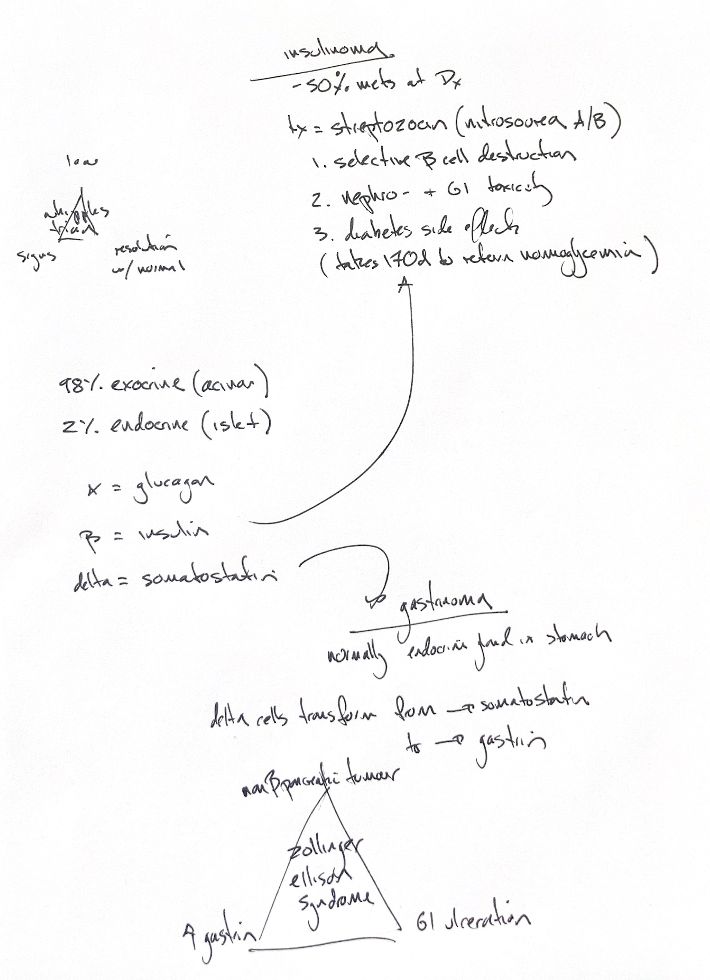
Think of two pancreatic compartments. Roughly 98% of pancreatic mass is exocrine tissue with its ducts, vessels and nerves. Acinar cells make digestive enzymes. The roughly 2% endocrine cue refers to islets, not a cell-count ratio. Alpha cells make glucagon, beta cells make insulin, and delta cells make somatostatin.
Insulinomas arise from neoplastic beta cells. Excess insulin can cause hypoglycemia. The original’s “about 50% metastatic at diagnosis” is a historical approximation. Staging affects what is detected. One primary series found metastases at surgery in 19 of 41 dogs, or 46%; later findings were recorded separately.
Keep Whipple’s triangle together: low blood glucose, compatible clinical signs, and signs that resolve when glucose normalizes. The pattern supports hypoglycemia as the problem, but it does not identify the cause by itself.
Streptozocin is a nitrosourea antibiotic; A/B is the original abbreviation for antibiotic. It selectively damages pancreatic beta cells and beta-cell tumour cells. The original lists nephrotoxicity, GI toxicity and diabetes mellitus. Damage to normal beta cells can reduce insulin production.
The “about 170 days to return to normoglycemia” cue needs a timing correction. In Moore’s 17-dog retrospective series, the median DURATION of normoglycemia was 163 days in the 14 stage II/III dogs. Dogs received streptozocin with saline diuresis. This was not a 170-day wait for glucose to normalize. The duration did not differ significantly from historical controls.
Gastrin normally comes from gastrointestinal G cells, including those in the stomach. The original links delta cells to gastrinoma through a proposed conversion from somatostatin to gastrin secretion. Exact tumour-cell lineage remains uncertain. The classic Zollinger–Ellison triangle joins a non-beta pancreatic tumour, high gastrin and GI ulceration. Excess gastrin raises gastric acid; gastrinomas can also arise outside the pancreas.
References
Chris Wood’s drawing; Johnston & Tobias, Veterinary Surgery: Small Animal, 2nd ed., ch97; Trifonidou et al.1998; Moore et al.2002, PMID12322919; Gal et al.2011; Struthers et al.2018, PMID29860931.