
Gestation and fetal imaging: event-specific clocks
Read the draft explanation
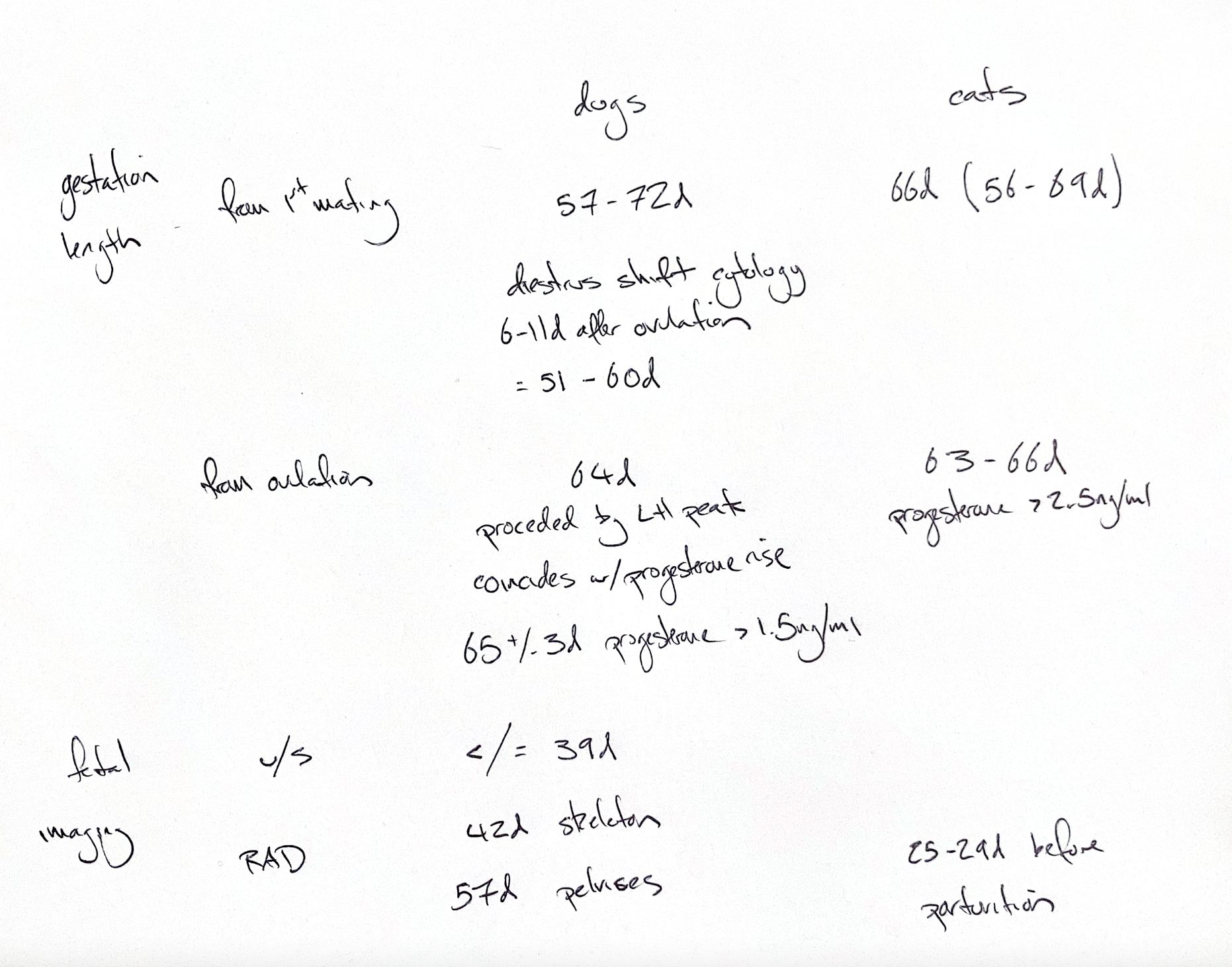
Gestation length depends on where you start counting. Parturition means birth. From first mating, dogs may take 57–72 days. In cats, mating to birth averages 66 days, with a reported range of 56–69 days. The handwritten feline upper limit is unclear and can read as 89 days; the supplied textbook gives 69 days, used here.
Hormone dates give a different clock. In dogs, the LH peak and early progesterone rise come before ovulation. LH means luteinizing hormone; P4 means progesterone. The study-note estimate is about 64 days from estimated ovulation. In the serial-sample progesterone study, birth was 65±3 days from the first sample at least 1.5 ng/mL AND at least twice baseline. That definition matters; one isolated result is not the same clock.
The canine diestrus shift is a change in the vaginal cells seen on cytology. It can occur 6–11 days after ovulation, leaving 51–60 days from that shift to birth. In cats, the textbook gives 63–66 days from the first day P4 exceeds 2.5 ng/mL. That is a hormone-defined starting point, rather than an exactly observed ovulation date.
Ultrasound can detect a canine gestational sac at 18–20 days after ovulation in the studies cited by the textbook. This is different from measuring structures to estimate age. In the cited dating study, measurements by day 39, counted from the LH surge, gave the better dating window. Day 39 is not the first day pregnancy can be detected. The puppy picture is a biometry schematic, not the appearance of an early sac.
For canine radiographs, the textbook cues are about gestational day 42 for the skeleton and day 57 for the pelvis. Those day labels should not be treated as exact detection guarantees. In cats, first skeletal mineralization was seen 25–29 days BEFORE birth in the cited study. Keep the species, imaging method, structure and starting event attached to every number.
These are study estimates from Johnston and Tobias, second edition, with the cited primary studies used to check their context. They are not a universal due date for every pregnancy.