
Open-fracture classification, source treatments and reported outcomes
Read the draft explanation
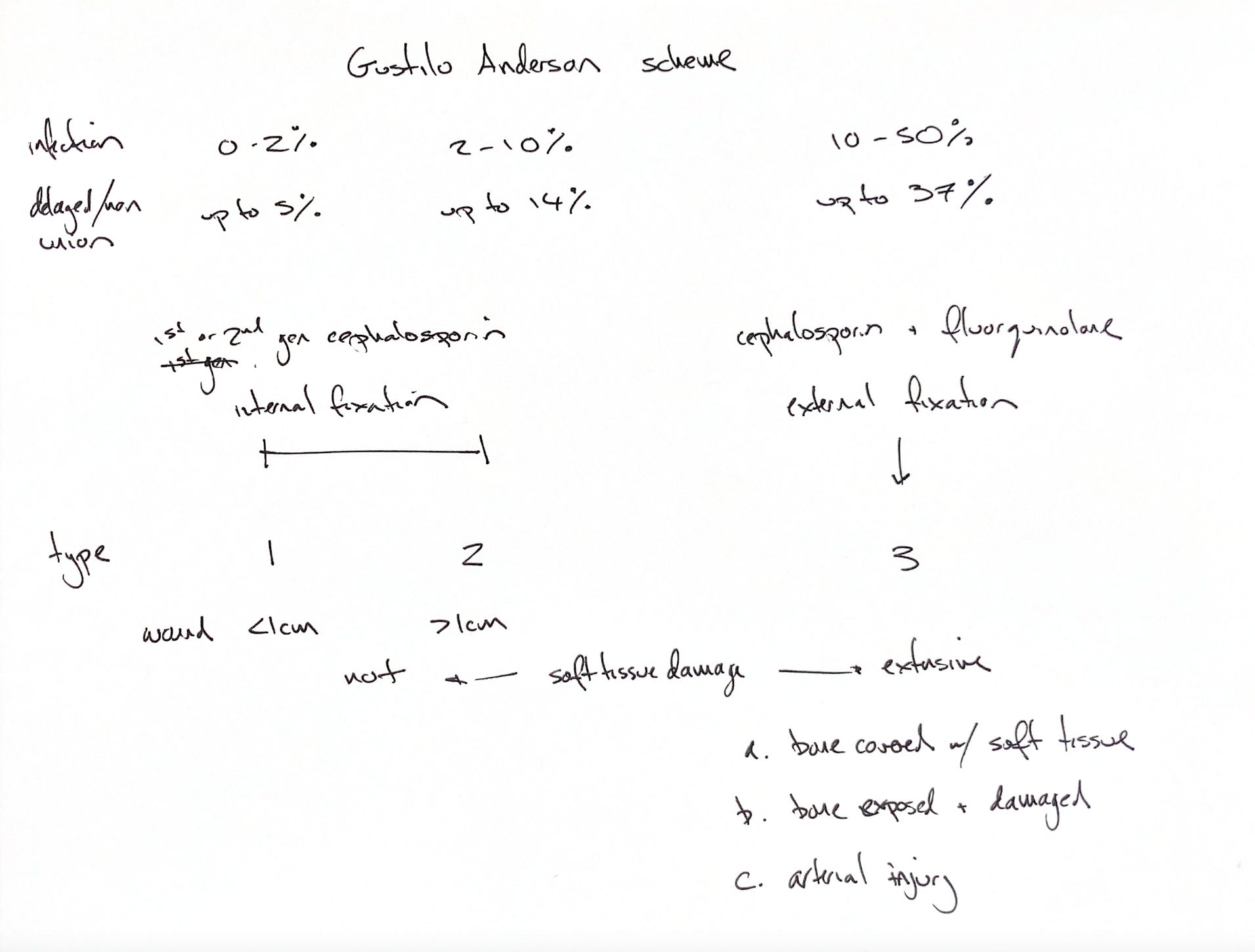
The Gustilo-Anderson scheme groups open fractures by the wound and the damage beneath it. Type I has a wound under 1 cm, often made from inside out by a sharp fragment. Type II has a wound over 1 cm without extensive tissue damage, flaps or avulsion. Wound length alone does not describe the injury.
Type III has extensive soft tissue damage. IIIA still has enough tissue to cover the bone. IIIB has tissue loss, periosteal stripping and exposed bone, often with heavy contamination. IIIC has an arterial injury that requires repair, whatever the wound size.
After treating life-threatening injuries, protect the wound and start intravenous antibiotics promptly. The source treatment options are a first- or second-generation cephalosporin for types I and II, and a cephalosporin plus a fluoroquinolone for type III. The latter broadens coverage while avoiding aminoglycoside toxicity. Ongoing treatment follows aerobic and anaerobic culture and susceptibility results, preferably from samples after debridement.
Fixation must provide stability, preserve living tissue and allow wound access. Types I and selected type II injuries may use the same fixation as a similar closed fracture. External skeletal fixation is useful when type III tissue damage makes internal fixation unsuitable. Internal fixation can still be used in selected type III injuries after adequate wound care.
The reported complication ranges come from historical human series: infection is 0–2%, 2–10% and 10–50% for types I, II and III. Delayed union/nonunion is 0–5%, 1–14% and 2–37%. These ranges combine different cohorts, treatments and follow-up periods; they do not give one pooled denominator or a dog's predicted risk. Higher-grade injury means less tissue support and a harder healing problem.
References
hand-drawn ACVS Phase One notes; Johnston and Tobias, Veterinary Surgery: Small Animal, 2nd edition, Chapter 40, Box 40.1 and Complications. Human-series references include Gustilo and Anderson 1976, DeLong et al. 1999 and Harley et al. 2002.