
Lasers: wavelength, absorption and tissue effects
Read the draft explanation
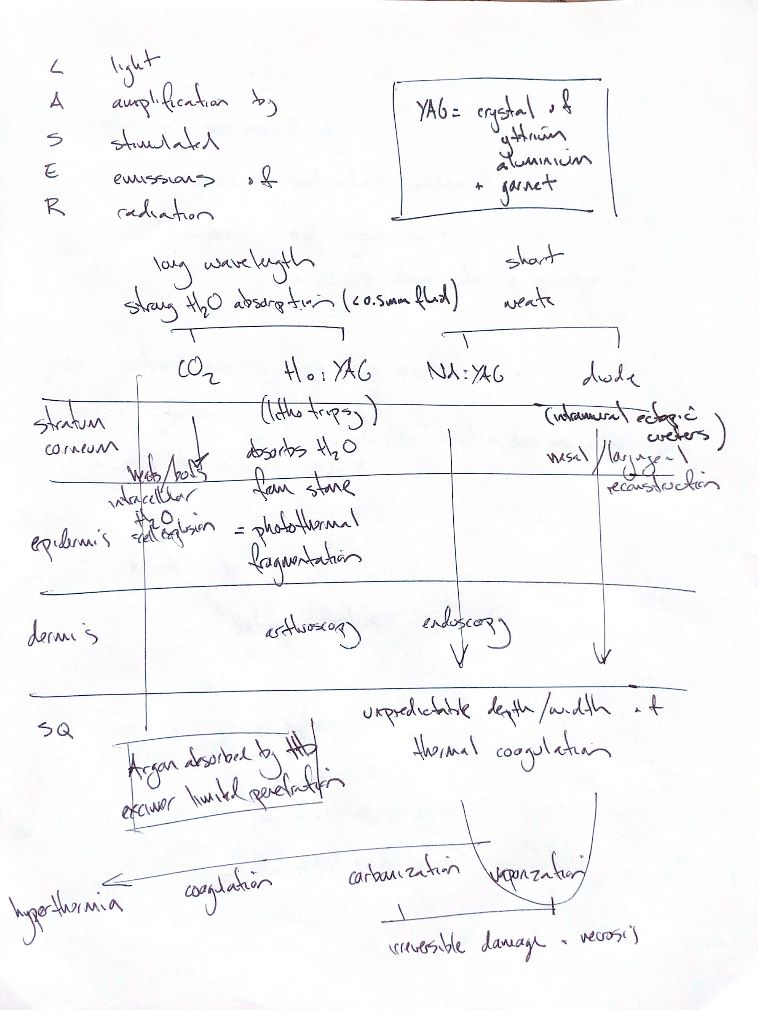
LASER means light amplification by stimulated emission of radiation. YAG is the yttrium aluminium garnet crystal host.
CO₂ and Ho:YAG absorb strongly in water, so their direct tissue effects are shallow. CO₂ rapidly heats intracellular water and vaporizes tissue. Ho:YAG breaks urinary stones mainly by photothermal fragmentation and also has arthroscopic uses.
The <0.5 mm fluid value is an optical absorption guide, not the full reach of an immersed Ho:YAG fibre. Vapour cavities can carry energy farther. An in-vitro fluid study found greater penetration with the fibre immersed than predicted from noncontact measurements.
Nd:YAG and diode light absorb less in water and interact more with tissue pigments. Light can scatter deeper, making the width and depth of thermal coagulation less predictable. Injury can become clear hours to days later. Nd:YAG can travel through flexible fibres for endoscopy. Diode can ablate intramural ectopic ureters and resect nasal or laryngeal tissue. Resection removes tissue; reconstruction rebuilds a defect.
Argon light is absorbed by hemoglobin. The absorbed energy becomes heat and coagulates vascular tissue. Its penetration is intermediate in this comparison. Excimer acts at the surface. It breaks molecular bonds by photochemical ablation, with little heating of nearby tissue.
Closest to the beam is vaporization, bordered by carbonization. Coagulation and thermal necrosis lie farther out. These zones represent irreversible injury. The outer hyperthermia zone may recover. Wavelength, power density, tissue properties and exposure change the final injury.
References
Benitez, ch.15 (Figs15.10–15.12), and Weisse, ch.23, in Johnston & Tobias, Veterinary Surgery: Small Animal, 2nd ed. Blomley et al.1995, PMID8850667. Berent et al.2008, PMID18380622.