
Unplanned marginal excision
Read the draft explanation
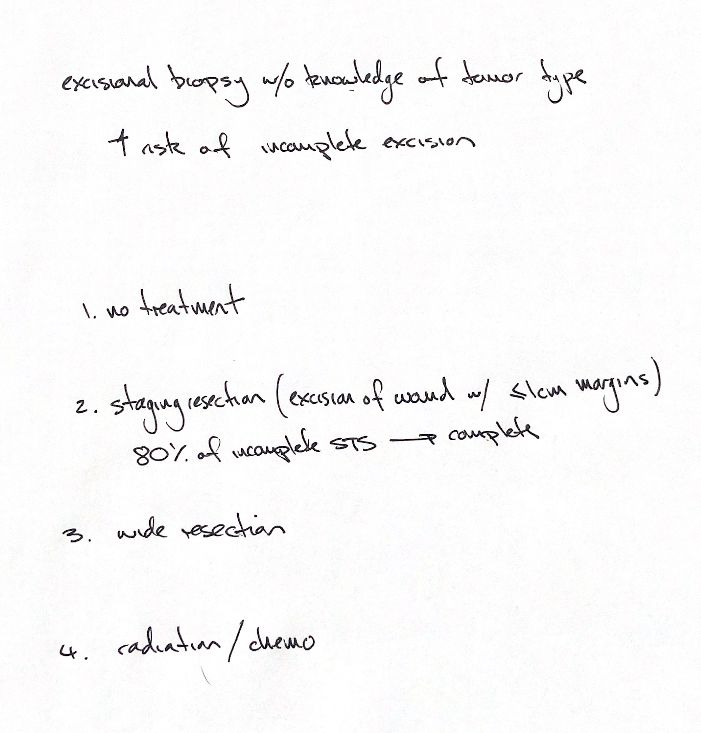
An unplanned marginal excision removes a mass before we know its tumour type. If the tumour is more invasive than expected, microscopic disease may remain. The first surgery can then make later treatment harder.
The options shown are selected observation, staging resection, wide resection, and radiation therapy and/or chemotherapy. The choice depends on tumour biology, grade, residual disease, anatomy and the patient.
A staging resection removes the scar or wound with margins of ≤10 mm for histology. It asks whether residual tumour can be found and helps guide the next step. It is different from a definitive wide oncologic resection.
The “about 80%” figure describes resected scars with no residual tumour detected. Bacon's retrospective series included 41 dogs after inadequate STS excision. Residual tumour was found in 9/41 scars, or 22%. No residual tumour was detected in 32/41, or 78%.
Those re-excision margins ranged from 0.5–3.5 cm. The 78% result therefore does not describe a uniform ≤1-cm staging excision. Local recurrence occurred in 6/39 dogs with follow-up, or 15%. Median follow-up was 816 days. Finding no tumour in the scar and avoiding later recurrence are different outcomes.
References
Johnston & Tobias, Veterinary Surgery: Small Animal, 2nd ed., ch25; Bacon et al.2007, JAVMA230:548–554, doi:10.2460/javma.230.4.548. Redrawn from my surgical study notes.