
Lavage and honey: what each local treatment does
Read the draft explanation
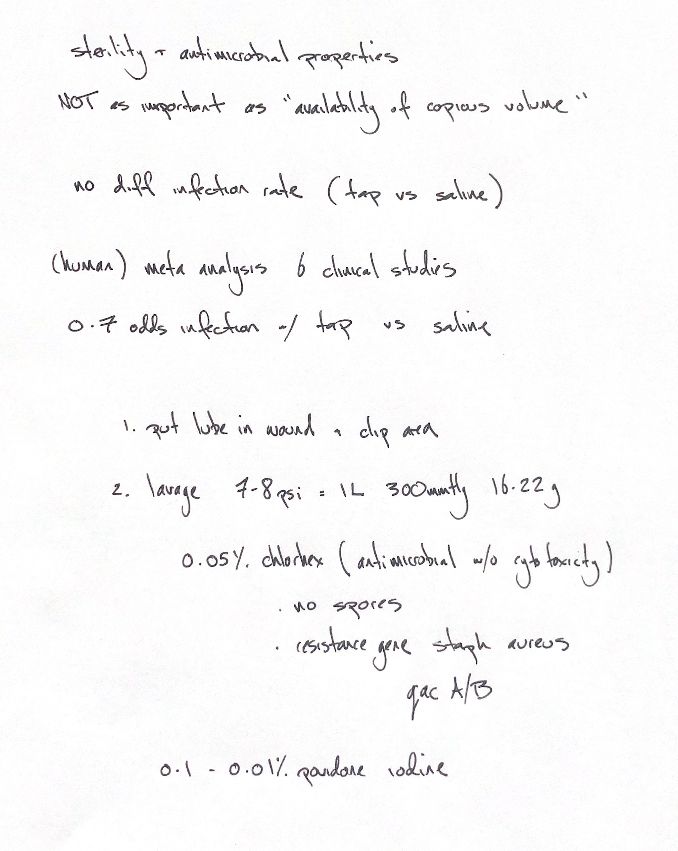
Lavage removes debris by flushing it away. Plenty of available fluid matters more than whether it carries an antiseptic label.
Human studies found no infection disadvantage with tap water compared with sterile saline. A six-study human meta-analysis reported OR 0.72, about 0.7. This compares infection odds in those human studies; it is not a veterinary infection probability or a result for every wound.
Before clipping, protect the wound with sterile water-soluble lubricant, then remove and flush it away. In one tested system, a 1 L bag inside a 300 mmHg cuff, with a fluid set and 16–22 G needle, delivered 7–8 psi. The cuff pressure differs from the pressure reaching the wound. Choose pressure with both contamination and tissue damage in mind.
The aqueous antiseptic options shown are chlorhexidine 0.05% and povidone-iodine 0.01–0.1%. Keep detergent scrubs out of open wounds. Chlorhexidine kills bacteria but is not reliably sporicidal. Hospital S. aureus can have qacA/B-associated reduced susceptibility. At 0.05%, chlorhexidine diacetate was toxic to fibroblasts in vitro, although healing was not impaired in the studied canine wound model. It can also precipitate in saline.
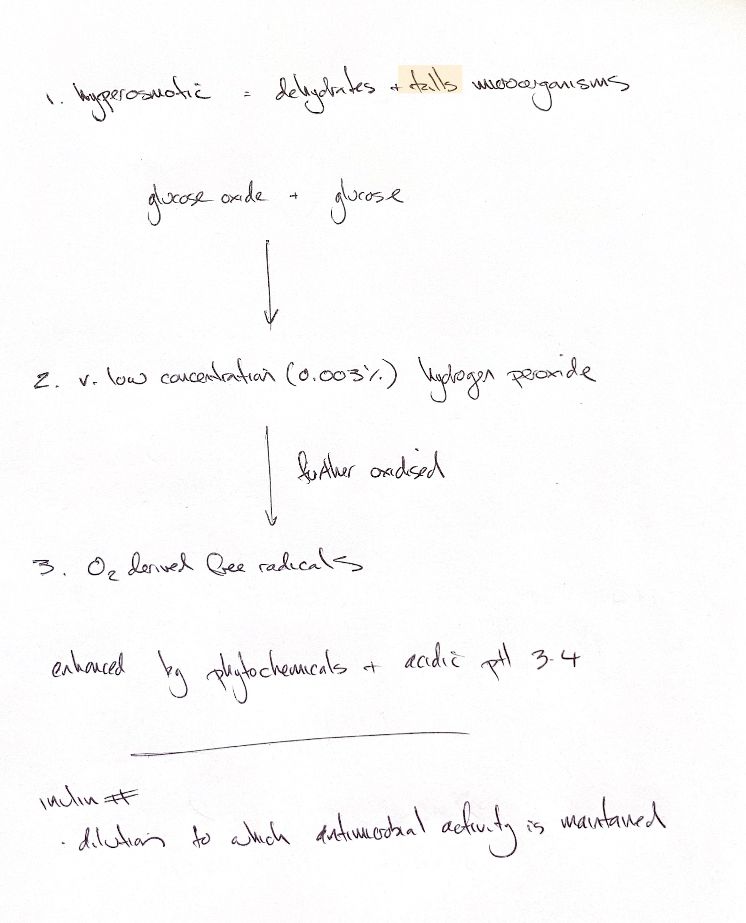
Honey draws water out of microbes through hyperosmolality, killing them or slowing growth. Glucose oxidase acts on glucose to make hydrogen peroxide. The reported concentration is about 0.003%, far below 3% peroxide lavage, and varies with the honey and dilution. Reactive oxygen species damage microbes; antioxidants can limit cell toxicity. Phenols, organic acids and pH 3.2–4.5 add nonperoxide activity. The inhibin number records how much honey can be diluted while retaining antibacterial activity. Historical test dilutions were 25%, 20%, 15%, 10% and 5%; the number does not measure clinical healing.
References
Johnston & Tobias, Veterinary Surgery: Small Animal, 2nd ed., chs 13, 76; Gall & Monnet 2010 (doi:10.2460/ajvr.71.11.1384); Sanchez et al. 1988 (doi:10.1111/j.1532-950x.1988.tb00995.x; doi:10.1111/j.1532-950X.1988.tb01019.x).