
The wound-healing phase map
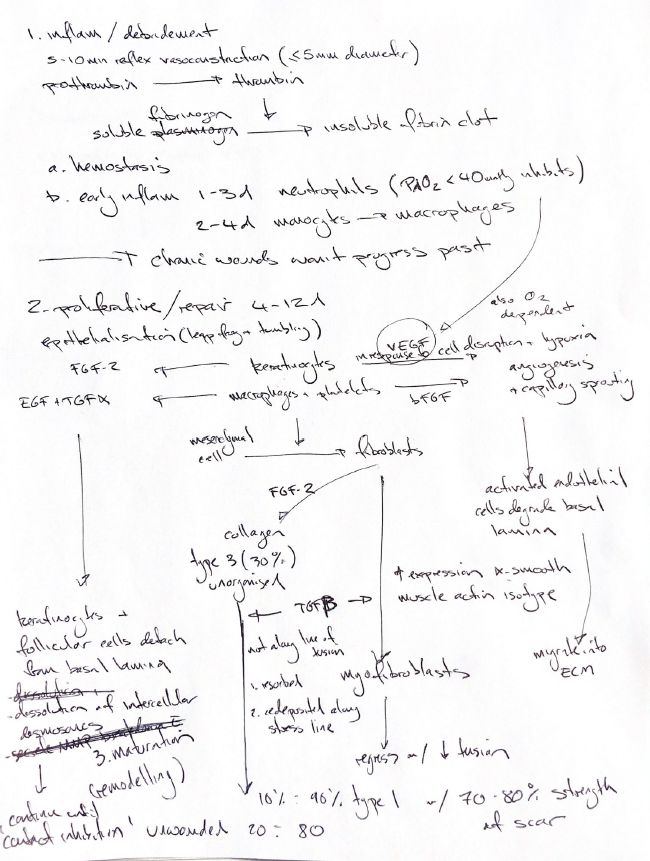
The revised Skin and Wounds draft flags “arterioles up to 5 mm” as an unresolved vessel-category discrepancy.
Read the draft explanation
Wound healing has three overlapping stages: haemostasis and inflammation/debridement, proliferation/repair, then maturation and remodelling.
Reflex vasoconstriction narrows vessels for about 5–10 minutes. This can briefly stop bleeding from transversely divided arterioles up to 5 mm wide. Thrombin turns soluble fibrinogen into insoluble fibrin, forming a fibrin–platelet clot.
Inflammatory cells arrive at different times in different wounds. Neutrophils need local oxygen to kill bacteria. In vitro, this is impaired below a PO₂ of 40 mmHg. A chronic wound can stay in inflammation.
Repair often spans days 4–12, depending on the wound and patient. Growth factors guide epithelial migration, fibroplasia and new vessel growth. Basal and follicular epidermal cells detach, desmosomes dissolve, and cells leapfrog and tumble through ECM remodelled by MMPs. Contact inhibition stops migration. VEGF and bFGF support capillary sprouting; endothelial cells need oxygen to respond.
Fibroblasts come from nearby mesenchymal cells. Macrophage and platelet signals, plus their own FGF-2, stimulate them to make collagen. TGF-β increases type I collagen, lowers MMP production and raises MMP inhibitors. TGF-β1 induces α-SMA and stress fibres, turning fibroblasts into contractile myofibroblasts. They regress as tension falls.
The early 30% type III figure refers to newly made collagen. In rat punch wounds, type III was 31.1 ± 2.8% (SE) of newly made types I + III at 10 hours, falling to about 20% by 24 hours.
During remodelling, fibres off the stress axis are removed and collagen is laid down along stress lines. Aligned bundles cross-link and thicken. Type III:I is about 20:80 in unwounded dermis and 10:90 in mature scar. Final scar strength reaches about 70–80% of unwounded tissue.
References
Johnston & Tobias, Veterinary Surgery: Small Animal, 2nd ed., chs. 9 and 76; Clore et al. 1979, doi:10.3181/00379727-161-40548. Redrawn from my surgical study notes.