
Laplace and Poiseuille equation reference
Read the draft explanation
Two equations explain different effects of radius.
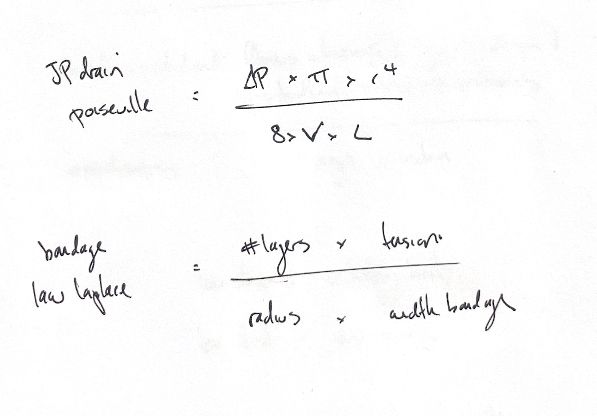
For a Jackson-Pratt drain, Poiseuille's law relates flow to the pressure difference, lumen radius, fluid viscosity and tube length:
F = ΔP × π × r⁴ / (8 × η × L).
A larger pressure difference drives more flow. A larger lumen has an even stronger effect because radius is raised to the fourth power. Double the radius and the model predicts 16 times the flow. Halve the length and it predicts twice the flow. Higher viscosity slows flow. Each comparison holds the other variables constant.
This is an ideal model for steady laminar flow of a Newtonian fluid through a uniform circular lumen. A patent drain and a stable pressure gradient matter when applying it to a real system.
Under a bandage, Laplace's relationship gives:
P ∝ (N × T)/(R × W).
N is the number of layers, T the applied tension, R the limb radius and W the bandage width. More layers or more tension increase pressure. A smaller radius also increases pressure. A wider bandage lowers it when the other variables stay the same.
This explains why narrow sites and bony prominences can receive more pressure than the wider part of the limb. Padding changes the local contour and effective radius. In the drain, increasing radius increases flow; under a bandage, decreasing radius increases pressure.
References
Johnston & Tobias, Veterinary Surgery: Small Animal, 2nd ed., ch. 19, bandage pressure and active drains. Equations matched to Chris Wood's original study sheet.