
Toceranib and KIT signalling
Read the draft explanation
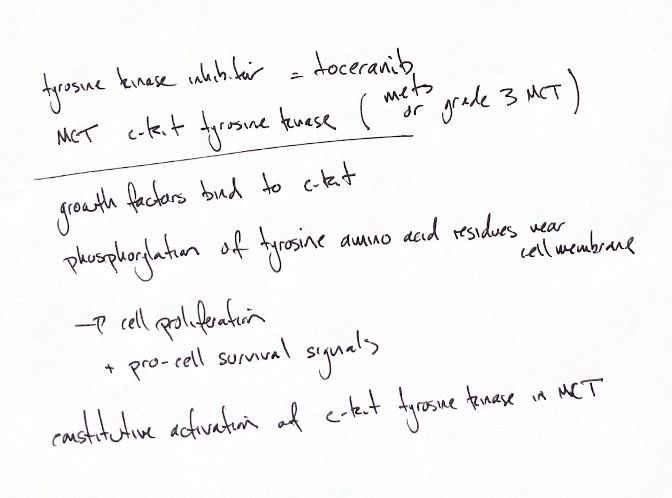
Toceranib is a small molecule that blocks receptor tyrosine kinases, including KIT.
Normally, stem cell factor binds KIT at the cell membrane. This activates the receptor's kinase and tyrosine-phosphorylation signals. These signals support cell proliferation, meaning more cells, and cell survival.
Some canine mast cell tumours have activating KIT mutations. These keep the signal switched on without stem cell factor: ligand-independent signalling. Toceranib inhibits that kinase activity. It also acts on other receptor tyrosine kinases.
Selected dogs with metastatic or Patnaik grade III MCT may benefit from systemic treatment with toceranib. This describes the disease setting; a detected KIT mutation is not required. Tumours without a detected mutation have also responded.
The U.S. labelled indication is more specific: recurrent cutaneous Patnaik grade II or III canine MCT, with or without regional lymph-node involvement. Tumour grade, stage and KIT signalling each inform case selection, but they describe different things.
References
Johnston & Tobias, Veterinary Surgery: Small Animal, 2nd ed., chs25/82; Palladia U.S. prescribing information: https://dailymed.nlm.nih.gov/dailymed/fda/fdaDrugXsl.cfm?setid=ae09ae83-0812-4ddc-92e3-730f7a1ae449 . Redrawn from my surgical study notes.