
Librela and Solensia for arthritis pain
What these monthly arthritis injections can help with and which changes to report.
Librela for dogs and Solensia for cats are monthly injections that can help with arthritis pain. Both target a protein involved in pain signals called nerve growth factor. Dr. Wood considers where your pet’s pain is coming from and checks how they respond to treatment.
Treatment benefits and safety
Dr. Wood discusses the reported cases of rapid joint damage and the potential for pain relief with owners before treatment.
Moving more easily is a good sign, but it does not mean the joint has healed. If your dog or cat develops a new limp, becomes less steady, or stops improving, have your vet check the change before the next injection.
Research behind this discussion: von Pfeil et al., 2026 · Michels et al., 2023
Before treatment
- Where is the pain coming from? A limp needs a diagnosis, even when a dog already has arthritis.
- What would improvement look like at home? Track how easily your pet gets up and walks, and how comfortable they seem at home.
- What else belongs in the plan? Weight control, suitable exercise, rehabilitation (planned exercises to help movement) and other pain medicines may all matter.
- When is the next reassessment? Agree with your vet on how to check benefit and any new problems.
If your pet already receives Librela or Solensia
Tell your vet what has improved and what has changed. Short videos from home can help show the difference. If your dog is doing well, speak with your vet about the benefits and risks before changing treatment. If there is a new problem, contact your vet before the next injection.
Do not add carprofen, meloxicam or another anti-inflammatory yourself. The Canadian product information states that the safety of long-term use together with Librela has not been established. Canadian product information, June 2024
Dogs on Librela: changes that need a call
Contact your vet promptly for new or worse limping, wobbliness, weakness, increased thirst or urination, or new urine accidents. Seek urgent care for a seizure, collapse or inability to stand. These signs can have several causes and need assessment. FDA safety communication
Research findings and limits
Open a topic for the research and its limits.
How Librela works—and what it does not repair
Bedinvetmab, the medicine in Librela, targets nerve growth factor, which helps carry pain signals. It is used for arthritis pain in dogs.
Blocking this pain signal can improve comfort, but it does not rebuild cartilage or repair a torn ligament. Your vet reassesses both comfort and joint function.
An explanation of the treatment’s purpose, not a prediction of an individual dog’s outcome. Canadian product information
The benefit studies: does it help with pain?
Corral, 2021: 287 dogs were assigned to Librela or a placebo, a comparison treatment with no active medicine, for three months. The study supported a benefit for arthritis pain. The longer extension followed 89 dogs already responding to Librela, with no continuing placebo group. That extension cannot describe how all dogs will respond. Read the study abstract.
Michels, 2023: a separate trial enrolled 272 dogs. At day 28, reported treatment success was 47.4% with Librela and 36.6% with placebo, based on owner pain scores. Results were available for 128 dogs receiving Librela and 131 receiving placebo. These are study results, not a promise that an individual dog will improve. Read the study abstract.
Both studies were associated with the manufacturer and were used to support approval of the medicine. Their results support pain relief but do not settle uncommon or long-term safety concerns.
von Pfeil, 2026: joint changes that need reassessment
This invited opinion article describes suspected rapid and unusual joint changes during treatment that blocks nerve growth factor, the protein involved in pain signals. These changes included bone damage, new bone formation and joints becoming unstable. The article brings together earlier reports and clinical examples; it is not a controlled trial.
The authors emphasise another examination when a limp changes, a joint becomes unstable or pain relief fades. The report cannot show how often these problems occur in all treated dogs, or prove that every change was caused by the drug.
It does not establish a standard six-month X-ray schedule. Imaging should follow the patient’s findings and needs.
Read von Pfeil et al., VCOT, 2026
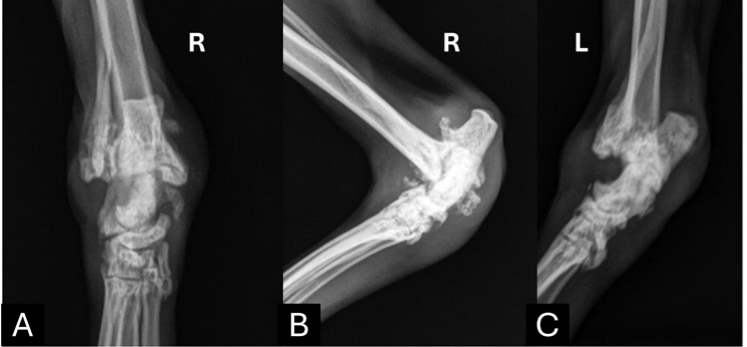
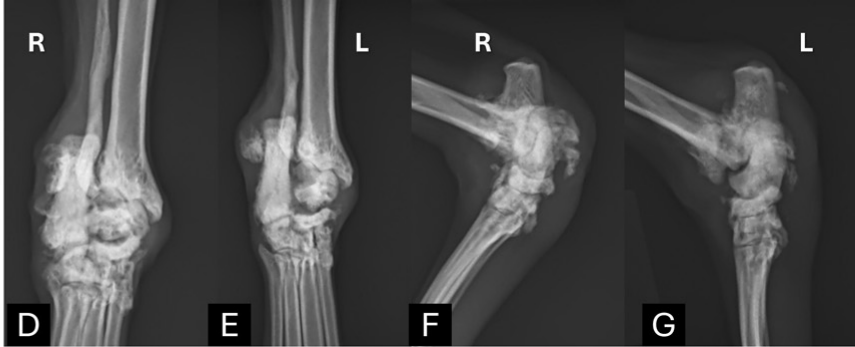
The images below show the same cat receiving frunevetmab (Solensia), not a dog receiving Librela. They illustrate the related feline discussion in this paper and do not establish the risk for dogs.
The 19-dog report: a safety signal, not a percentage risk
Farrell and colleagues described 19 selected dogs with suspected joint problems after treatment and analysed reports submitted after the medicine was used. The cases raise concern about a possible link with joint damage that develops unusually quickly.
These 19 dogs were selected because something had gone wrong. They were not a representative sample of all dogs receiving Librela. The paper therefore cannot give an owner’s dog a percentage risk.
A later commentary by Lloyd challenges the reporting comparison and selection methods. In particular, comparing the number of reports alone does not establish a ninefold risk of harm. This disagreement is important when interpreting the headline findings.
Farrell et al., 2025 · Lloyd’s methodological commentary, 2025
Newer studies: what they add
A 2026 trial followed 28 obese dogs for 56 days. It reported improvements in pain and activity with bedinvetmab, with no adverse effects reported. A small, short study cannot exclude uncommon or delayed harm. Read the study.
Another 2026 study compared bedinvetmab with grapiprant in 32 dogs over two months. A plate measured how much weight each dog put on the leg. The trial tested whether bedinvetmab’s pain relief fell short of grapiprant by more than a limit set before the study. It did not cross that limit. That does not establish that Librela is better or safer. Read the study abstract.
Safety information and other medicines
The Canadian information reviewed here is dated June 2024. It identifies Librela as a treatment for arthritis pain and notes the lack of long-term safety data for use alongside non-steroidal anti-inflammatory drugs (NSAIDs), such as carprofen or meloxicam. Your vet should check the latest prescribing information for your dog.
The FDA subsequently highlighted reports of problems involving the nerves or brain, and problems with urination, with death or euthanasia in some cases. A report after treatment is not, by itself, proof that treatment caused it. It is a reason to investigate and report suspected reactions.
Solensia: the evidence in cats
A study randomly assigned 275 cats with arthritis pain to frunevetmab or a placebo, a comparison treatment with no active medicine. Owners reported an improvement in how well their cats could move. A short trial cannot settle uncommon or long-term safety concerns. Read the feline trial.
For a cat receiving Solensia, report new health or behaviour changes to the treating vet, including skin irritation or an allergic reaction. Breathing difficulty or collapse needs urgent care. Canadian Solensia owner information.
Same approach, species-specific medicines
Librela contains bedinvetmab for dogs; Solensia contains frunevetmab for cats. They use the same type of approach to pain relief, but they are different medicines. Dog study results are not a measure of the risk or benefit for cats.