
Emergency surgery · Dogs and cats
Bowel surgery: blockage, damage and leakage
A swallowed object can block the stomach or intestine (bowel). Damaged or leaking bowel may need surgery to remove the cause, repair the gut and treat infection.
Overview
Blockage and bowel damage
Food normally passes from the stomach into the intestines, also called the bowel. These organs sit inside the belly, or abdomen.
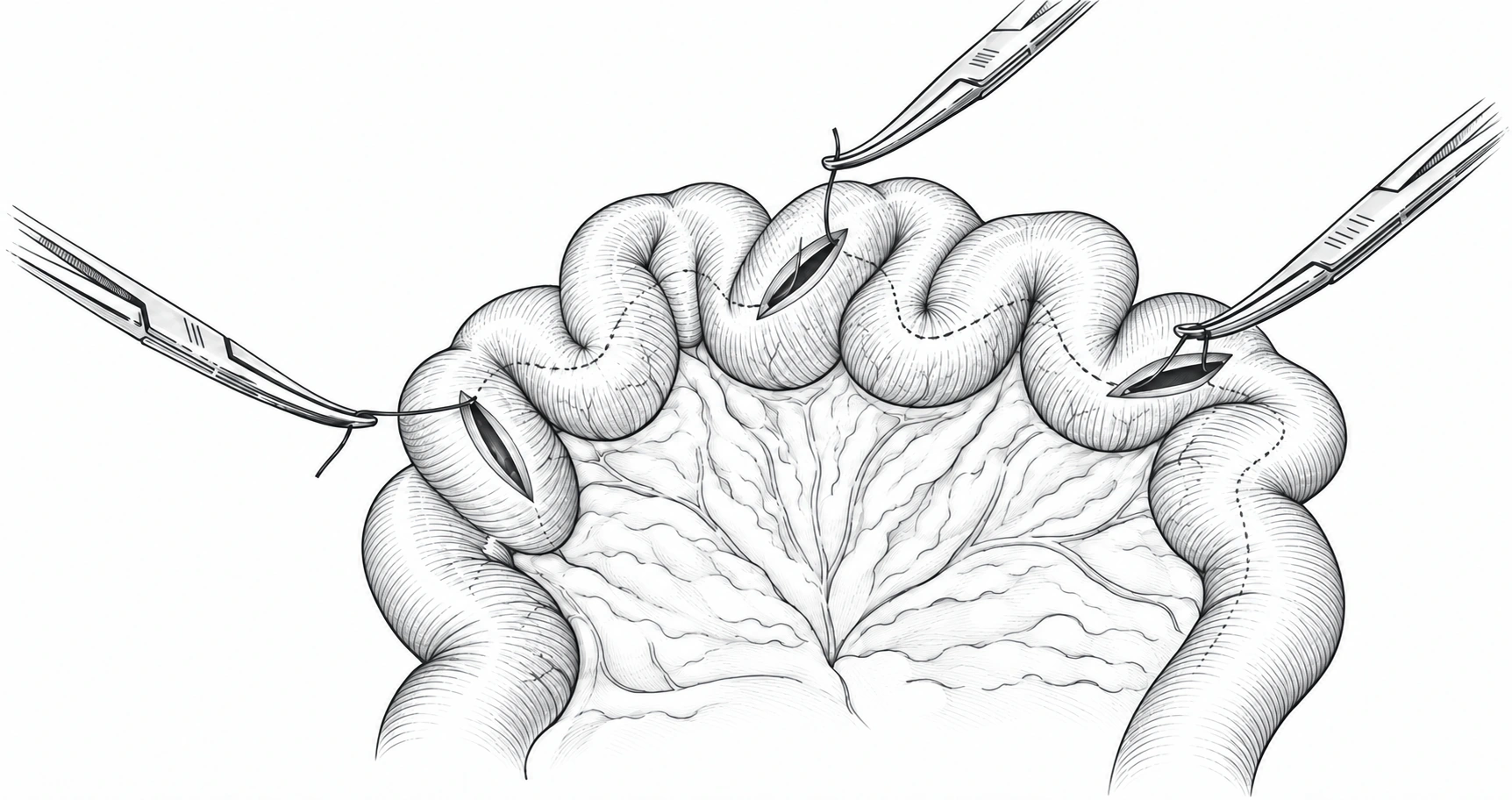
A foreign body is a swallowed object, such as a toy, sock or string. It may block the passage of food and fluid. Pressure from a blockage can damage the bowel. String or similar material is called a linear foreign body. It can pull the bowel into folds and cut into it.
If the bowel leaks
Gut contents can escape through a hole or a failed bowel repair and cause a life-threatening infection around the organs inside the belly. This is called a septic abdomen or septic peritonitis.
A swallowed object is one possible cause. Diseased bowel, a previous operation or another abdominal organ can also be the source of infection. The team needs to find the cause as well as treat the infection.
Signs and symptoms
Your pet may vomit, stop eating, become quiet or weak, or have a painful or swollen belly. Diarrhea can also occur. These signs have several possible causes; an examination and tests are needed.
Tell the team what may be missing or chewed, and when your pet may have swallowed it. If your pet recently had bowel surgery, tell them when it was done and when your pet started to deteriorate.
Persistent vomiting or failure to improve needs prompt reassessment, even after medicine has reduced the vomiting. A pet with a leak can become seriously ill quickly.
Diagnosis
Is there a blockage, damage or infection?
The team examines your pet and checks hydration and blood flow. Blood tests help assess the effects of the illness. X-rays and ultrasound help locate an object and look for blockage or leakage. Fluid from inside the belly may be sampled and checked for bacteria and other signs of infection.
Tests do not always show the full extent of bowel damage. Sometimes surgery is needed to find the cause of worsening illness, even when the images do not give a clear answer. Emergency treatment starts while the team looks for the cause.
Treatment
Removing a blockage or stopping a leak
Your pet may need fluids given through a vein, pain relief and treatment for poor blood flow before and during surgery. A small object may pass under hospital monitoring. Some objects in the stomach can be retrieved by endoscopy: a flexible tube with a camera passed through the mouth.
A stuck object, worsening blockage or signs of bowel damage may need surgery.
For abdominal surgery, general anaesthesia keeps your pet fully asleep. Dr. Wood examines the stomach and bowel through an opening in the belly before choosing the repair.
If gut contents are leaking, antibiotics treat the bacteria and hospital care supports your pet, but the leak also needs to be stopped. During surgery, Dr. Wood repairs or removes damaged tissue and removes contaminated fluid.
The repair may only become clear when Dr. Wood examines the bowel during surgery.
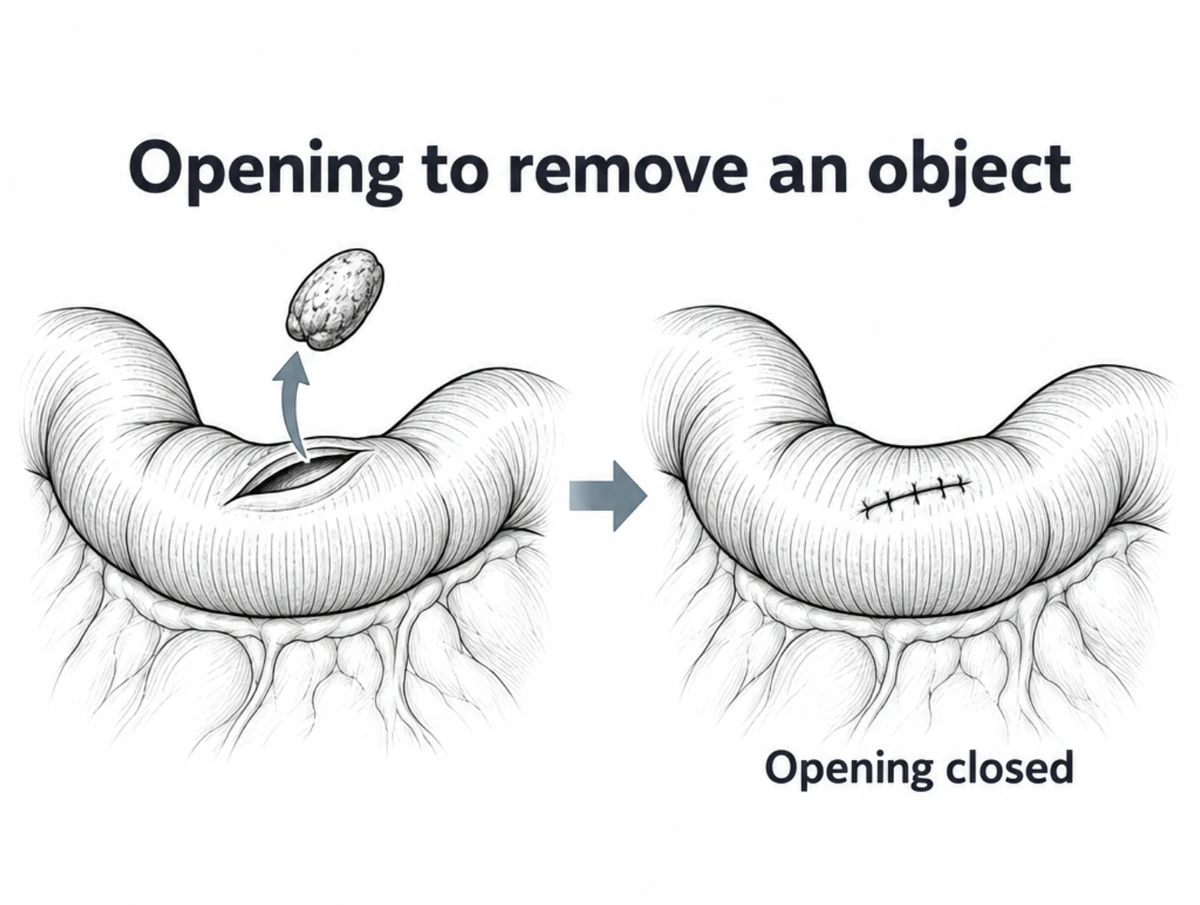
Remove an object through an openingGastrotomy or enterotomy
Gastrotomy: an opening in the stomach to remove the object.
Enterotomy: an opening in the intestine when the surrounding bowel can be kept.
A closer look at string-like material in the bowel
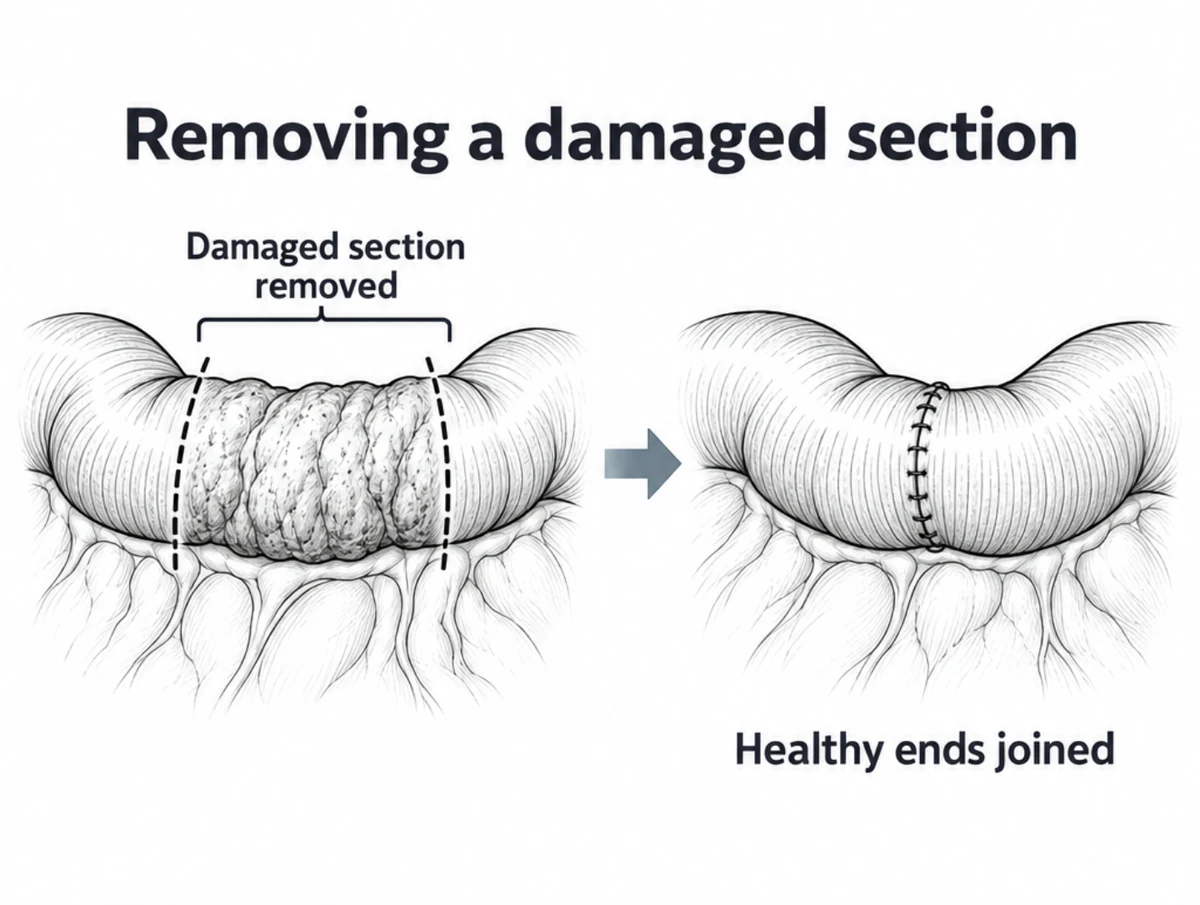
Remove damaged bowel and join the healthy endsResection and anastomosis
Resection and anastomosis: removing badly damaged bowel and joining the healthy ends.
Repairing damaged or leaking bowel
Dr. Wood checks which parts of the bowel are healthy enough to heal. A bowel join may use staples. The repair depends on blood flow, damage, bowel size and whether the ends can meet without being pulled too tightly.
Even a carefully made join can leak as damaged tissue heals. Dr. Wood explains that risk before surgery and plans monitoring around it.
After bowel surgery: watch especially closely on days 3–5. Warning signs and when to call →
Aftercare and outcome
The bowel needs time to heal
In hospital, the team monitors circulation, organ function, pain, nutrition, vomiting and signs of infection or leakage. A pet with damaged bowel or infection may need a longer stay, drainage of infected fluid, feeding support, a transfusion or another operation.
The team decides when your pet is well enough to go home. Eating and being able to take medicines by mouth are part of that decision. The bowel is still healing after discharge, so the warning signs above still apply. Recovery depends on the bowel damage, any leakage and the response to treatment.
Before you go home
Make sure your pet’s written discharge plan explains:
- What to feed, how much and how often.
- Each medicine’s dose and times, including pain relief.
- Activity limits, wound protection and what to check each day.
- When rechecks are needed and which number to call.
Ask the team to explain anything you are unsure about. Follow your pet’s individual plan, and keep objects they may swallow out of reach.
Veterinary referral checklists
Veterinary teams: foreign-body referral checklist
Call to confirm transfer and surgeon availability. Do not delay stabilization or transfer for paperwork.
Send available records
- Suspected object, ingestion time and onset/duration of signs; emesis/endoscopy attempts.
- Perfusion findings; fluids, medicines and response.
- Original images and reports.
- CBC/chemistry/electrolytes; lactate, blood gas and abdominal-fluid results if done.
- Flag linear material, free fluid/gas, suspected perforation or worsening obstruction.
Veterinary teams: septic-abdomen referral checklist
Call to confirm urgent transfer and Dr. Wood’s availability. Do not delay urgent care to complete the checklist.
- Examination findings and timeline.
- Original images, blood results and abdominal-fluid cytology/culture, if obtained.
- Current drugs, fluids/blood products and response.
- After bowel surgery: operative report and timing of deterioration.
Bowel repair and septic abdomen: evidence for veterinary teams
Illness, response to treatment and care needs
No single blood result can show how a dog will recover. Assessment includes the patient’s condition, blood results, response to initial treatment and the expected operation and hospital care.
Lactate study · Clinical findings study · Intestinal dehiscence study
Evidence in dogs with septic peritonitis
Davis and colleagues reviewed 210 bowel joins in 198 dogs. In the subgroup with infection before surgery, reported leakage from the join was 9.7% with stapled joins and 28.9% with hand-sewn joins. The study supports considering stapling in these patients, but it was retrospective and included only dogs that survived at least 72 hours. These are study results. They do not describe Dr. Wood’s complication rates.
Davis 2018: septic peritonitis and anastomotic technique
Reinforcing the transverse staple line
Sumner's study included 77 dogs and 78 stapled joins. Leakage occurred at 0 of 30 oversewn sites and 7 of 48 sites without oversewing. This is encouraging clinical evidence for reinforcement, but a small observational study cannot establish zero risk.
Sumner 2019: suture reinforcement
Offset, oversewing and crotch sutures
These describe details of how staple lines meet and how the join is reinforced. Cadaver studies show that configuration can change the pressure at which a fresh join leaks. Hansen and Smeak found better initial leakage resistance with partial staple-line offset. Duffy and colleagues studied transverse-line oversewing and reinforcement at the junction between bowel limbs, often called the crotch.
These are mechanical studies in tissue outside a living patient. They help inform technique; they do not prove better survival in septic patients or establish one repair for every bowel.
Hansen and Smeak 2015 · Duffy 2022: crotch reinforcement
What the evidence does not settle
DePompeo's 180-dog cohort reported leakage in 4/87 stapled and 12/93 sutured cases. However, significance was lost when albumin, a blood protein, was included in an analysis with incomplete data, and later impaction occurred at some stapled sites. Published comparisons are not a guarantee and do not establish that one surgeon is better than another.
DePompeo 2018 · Campbell and O'Marra: septic-peritonitis review