
Carprofen (Rimadyl) for dogs
By Dr. Chris Wood, DACVS-SA · Medically reviewed September 10, 2026
Carprofen is a non-steroidal anti-inflammatory drug, often shortened to NSAID. It helps reduce pain and swelling. Rimadyl is one brand name. Carprofen is Dr. Wood’s usual choice of anti-inflammatory for dogs.
Use your dog’s prescription for the amount and times. If a dose is missed or the instructions are unclear, call the veterinary team that prescribed it to confirm the plan. Have the medicine container and discharge sheet with you.
Why Dr. Wood usually chooses carprofen
Dr. Wood has operated on dogs with ulcers that made a hole in the first part of the intestine, just past the stomach. These are called perforated duodenal ulcers. That experience is one reason he pays close attention to stomach and bowel side effects.
Carprofen can still cause side effects. Dr. Wood checks your dog’s health, other medicines and past reactions before prescribing it. The studies below explain his usual choice.
Small erosions are surface injuries to the stomach lining. They are different from a hole through the stomach wall. Mabry et al., 2021.
What if your dog takes another medicine?
Your dog does not need to switch if their current anti-inflammatory is working well and remains suitable.
For long-term use, Dr. Wood generally prefers carprofen. When switching medicines for a suitable dog, his usual plan includes a three-to-five-day break. Some dogs need longer. The team will give you the exact stop and start dates and can recheck bloodwork soon after starting or changing treatment.
What to watch for at home
Stop carprofen and call your veterinary team if your dog vomits, has diarrhoea, eats less, seems unusually tired, has black stools, drinks more, or has yellow eyes or gums.
Get urgent help for collapse, blood in vomit, or a suspected overdose. Serious gut, kidney or liver problems can occur. Canadian product information
Giving the medicine safely
Follow your dog's prescription. Do not add doses or extend the course yourself. Keep chewable tablets out of reach.
Do not combine carprofen with another anti-inflammatory or a steroid such as prednisone unless your vet has specifically directed the treatment. Ask the prescribing vet before adding a stomach protector such as omeprazole. It is not needed for every dog, and adding it can affect the gut. Canadian product information · Jones, 2020
Studies and figures
Open a study for its findings and limits.
The 2025 study: carprofen after stomach or intestinal surgery
Researchers reviewed the records of 721 dogs having surgery to remove swallowed objects. Of these, 69 received carprofen after surgery:
- 43 had an opening made in the stomach, which was then closed.
- 11 had an opening made in the intestine, which was then closed.
- 15 had a section of intestine removed and the remaining ends joined together.
That means 26 of the carprofen-treated dogs had intestinal surgery, and 43 had stomach surgery. No leakage from the surgical repair was recorded in any of the 69 dogs receiving carprofen. The study did not find an increased rate of leakage or slowing of movement through the intestines with carprofen.
The surgeons chose which dogs received it based on the health of the bowel. Dogs with infection already present in the abdomen at surgery were excluded. The treated group was small, so an uncommon complication could have been missed.
These findings support considering carprofen after these operations when the surgeon judges it appropriate. It does not guarantee that a repair will heal without complications. Riddle, 2025
26 intestinal operations + 43 stomach operations = 69 dogs receiving carprofen. Diagram based on Riddle et al., Table 1.
Studies comparing stomach and bowel side effects
A small study of 36 healthy dogs found the fewest stomach and bowel side effects with carprofen among the medicines tested. Another study of 24 dogs did not find a clear difference in stomach injury between the groups. These studies do not establish one medicine as safest for every dog. Luna, 2007 · Forsyth, 1998
The Pfeifer study: common use, no cases in the single-drug group
Carprofen was the most commonly prescribed NSAID reported by the surveyed veterinarians. None of the 18 dogs that developed a hole in the stomach or intestine while taking a single NSAID at its labelled dose was taking carprofen.
Pfeifer and colleagues reviewed 30 dogs with a hole in the stomach or upper intestine after NSAID exposure. Across the two periods covered by the prescribing survey, 70.6% of responses named carprofen as the most frequently prescribed NSAID. It accounted for 0 of the 18 single-NSAID, labelled-dose perforation cases.
The 70.6% describes survey responses, not the percentage of all dogs treated. Carprofen appeared in five other perforation cases involving overlapping medicines, and the study could not calculate the risk of perforation per dog treated with each drug. Pfeifer, 2022
Understanding the meloxicam ulcer study
A 2021 experiment deliberately used meloxicam to produce stomach ulcers. All ten treated dogs developed deep ulcers by day 15. However, the repeated daily dose was twice the Canadian labelled maintenance dose, and no dogs received carprofen for comparison.
This study shows how serious injury can develop under those conditions. It cannot show how often ulcers occur during routine prescribed treatment or prove that carprofen is safer. Elfadadny, 2021 · Canadian meloxicam label
Why the length of treatment matters after bone surgery
In a small experimental bone-surgery study, eight weeks of carprofen affected some measures of healing. Two weeks did not show the same effect on X-ray assessments. This was not a study of pet dogs recovering from TPLO and does not set a stopping date for your dog. It is a reason for your surgeon to review the length of treatment alongside comfort and healing. Gallaher, 2019
Jones: should a stomach protector be added?
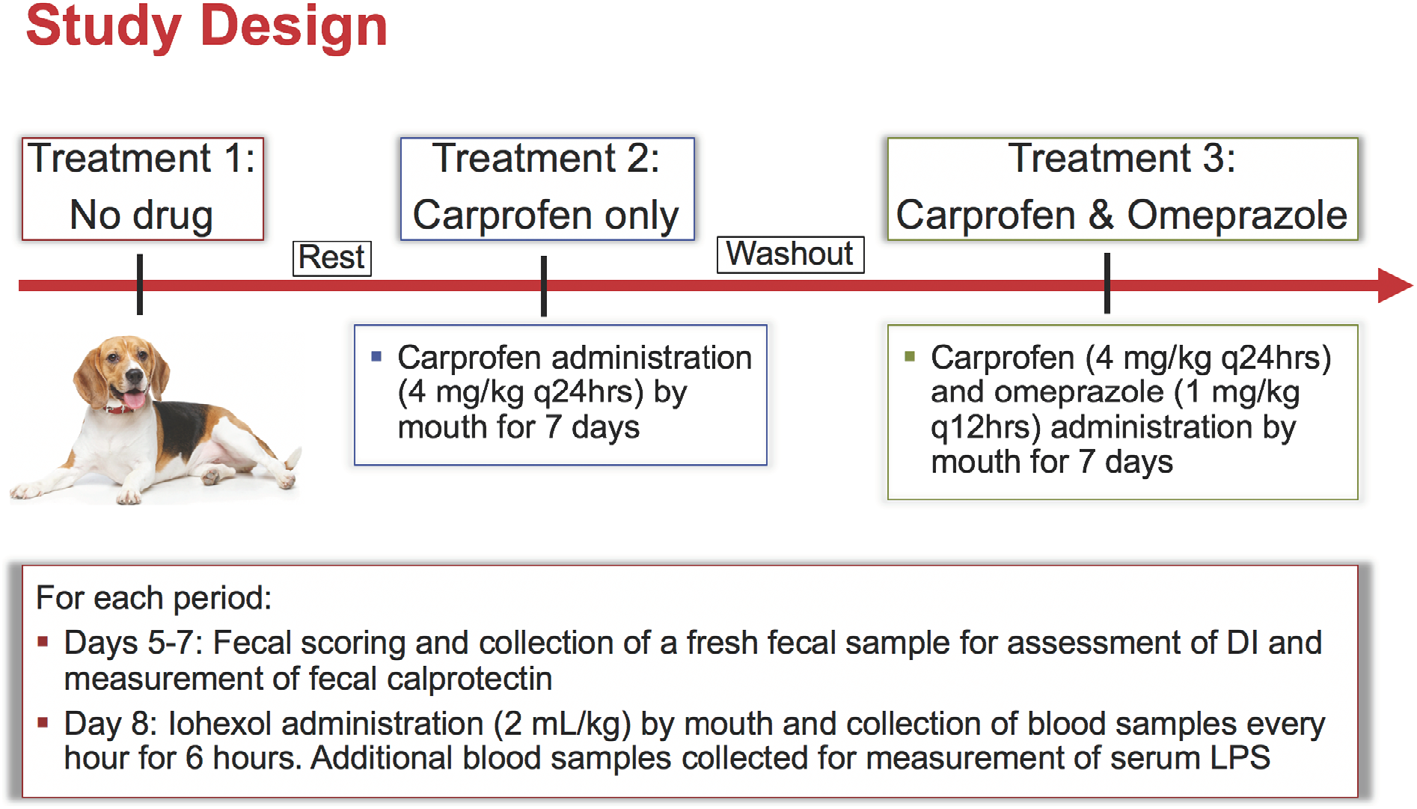
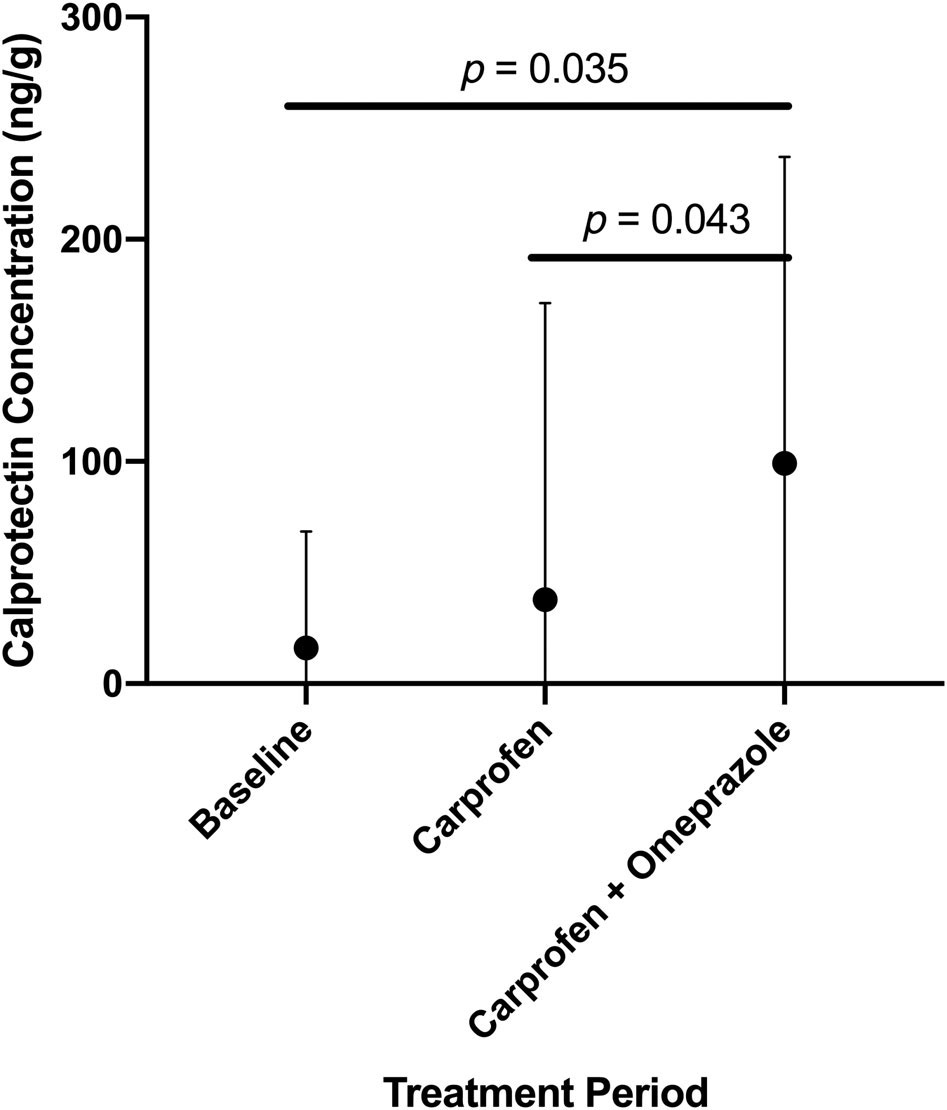
Ask your veterinarian before adding omeprazole as a “stomach protector.” In a study of six otherwise healthy dogs with no other risk factors for bleeding in the stomach or intestines, adding omeprazole to carprofen as a precaution disrupted the balance of gut bacteria and increased a marker of intestinal inflammation compared with carprofen alone or no treatment.
The marker was calprotectin, a protein found mainly in a type of white blood cell. Measuring it in stool helps assess inflammation in the intestines. A higher level is an inflammation signal; it does not, by itself, prove an ulcer or a perforation.
This study supports not adding omeprazole automatically as a precaution with carprofen in otherwise healthy dogs. Omeprazole may still be appropriate for a specific medical reason. Do not stop a prescribed medicine without speaking with your veterinary team. Jones, 2020
This seven-day study used six dogs in the same treatment order. It had no omeprazole-only group. Tests of how easily substances passed through the gut wall did not show a significant change.
Mabry: sores in the stomach and intestine
A small study used a swallowable camera to examine dogs receiving NSAIDs for at least 30 days. Ten of the 12 treated dogs had erosions. Nine dogs were receiving carprofen, two meloxicam and one firocoxib. Erosions were seen with all three medicines.
Carprofen can also affect the gut. These selected cases cannot establish the chance of injury for every dog taking an NSAID. The figure captions do not identify which medicine each pictured dog received. Mabry, 2021
Mabry et al., 2021, Figure 1 (stomach erosions).
Mabry et al., 2021, Figure 2 (small-intestinal erosions).
Dobberstein: surgical repair of ulcers
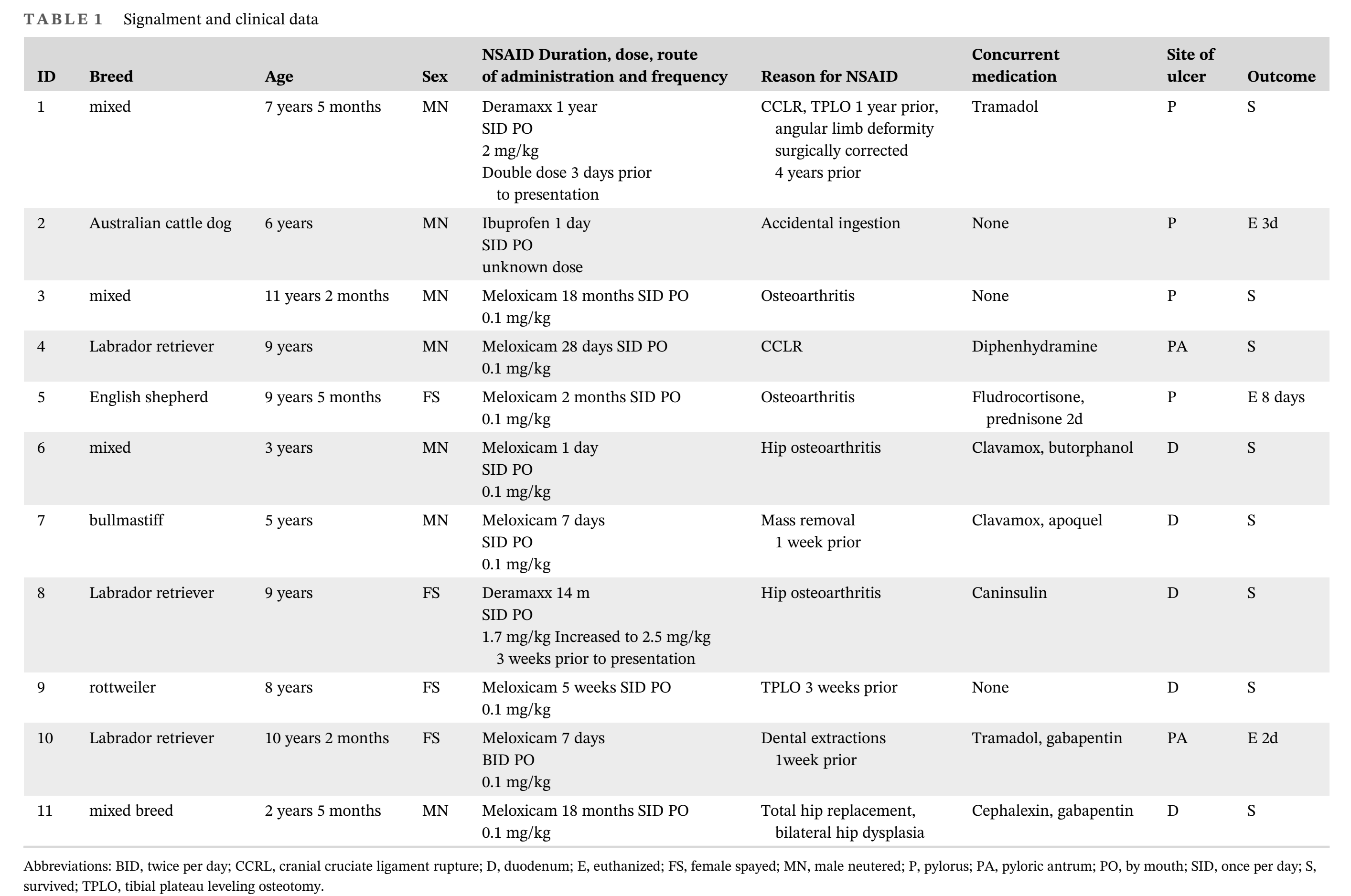
This report describes surgery to repair ulcers that made holes through the stomach or intestinal wall in 11 dogs with NSAID exposure. The table records the medicines, doses, other drugs and outcomes for those cases. It is a case series, not a comparison of the risk for each medicine. Dobberstein, 2022
Pain relief: what the studies show
Studies in dogs with arthritis have shown improved comfort and use of the affected leg with carprofen. After surgery, it may be one part of a pain-relief plan that includes other medicines or a local anaesthetic. Different treatments can work together to keep your dog comfortable. Vasseur, 1995 · Budsberg, 2018 · Bergmann, 2007