TPLO complications:what owners should know
Many dogs do well long term after TPLO, but every surgery has risks. This page explains known complications, when to call, and what studies have found. It cannot diagnose one dog.
- No weight on the operative leg AND the leg is sore when gently touched.
- The knee feels hot AND there is active discharge from the incision.
Is this an expected early change or a reason for advice?
Mild bruising, swelling lower down the leg, and uneven leg use can occur early in recovery. A new change or one that is getting worse deserves advice. If you are unsure, send an update or call. Do not try to name the problem at home.
Complications discussed after TPLO
Studies do not all count problems in the same way. They also include different dogs and follow them for different lengths of time. The numbers below add context. They cannot predict one dog's result.
How the incision is closed and checked
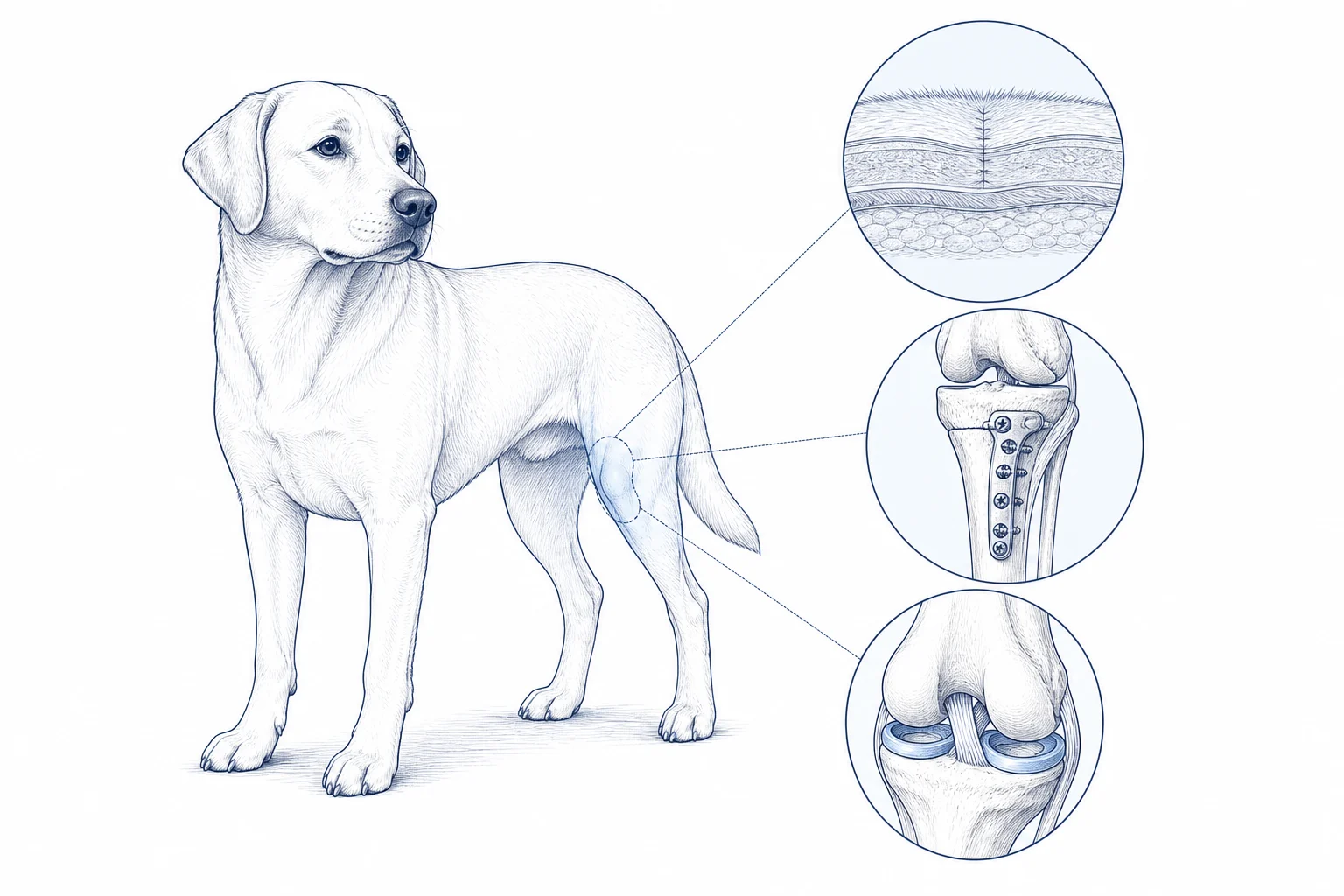
The TPLO incision is closed in layers. Under the skin, I place an extra stitch in the upper third before closing the skin with stitches rather than staples.
A study of 189 TPLO incisions found that the upper third was the most common place for a small skin-edge opening. This finding informs both the extra stitch and the attention given to that area during incision checks. It does not prove that the stitch prevents an opening.
A separate two-centre referral study found that 144 of 4,813 TPLOs (3.0%) developed a deep infection that led to plate removal. A small skin opening and a deep infection are different problems. These published results are not my personal rate or a prediction for one dog.
If you are checking an incision today, use the incision and licking guide.
Slow bone healing, fracture, or movement of the repair
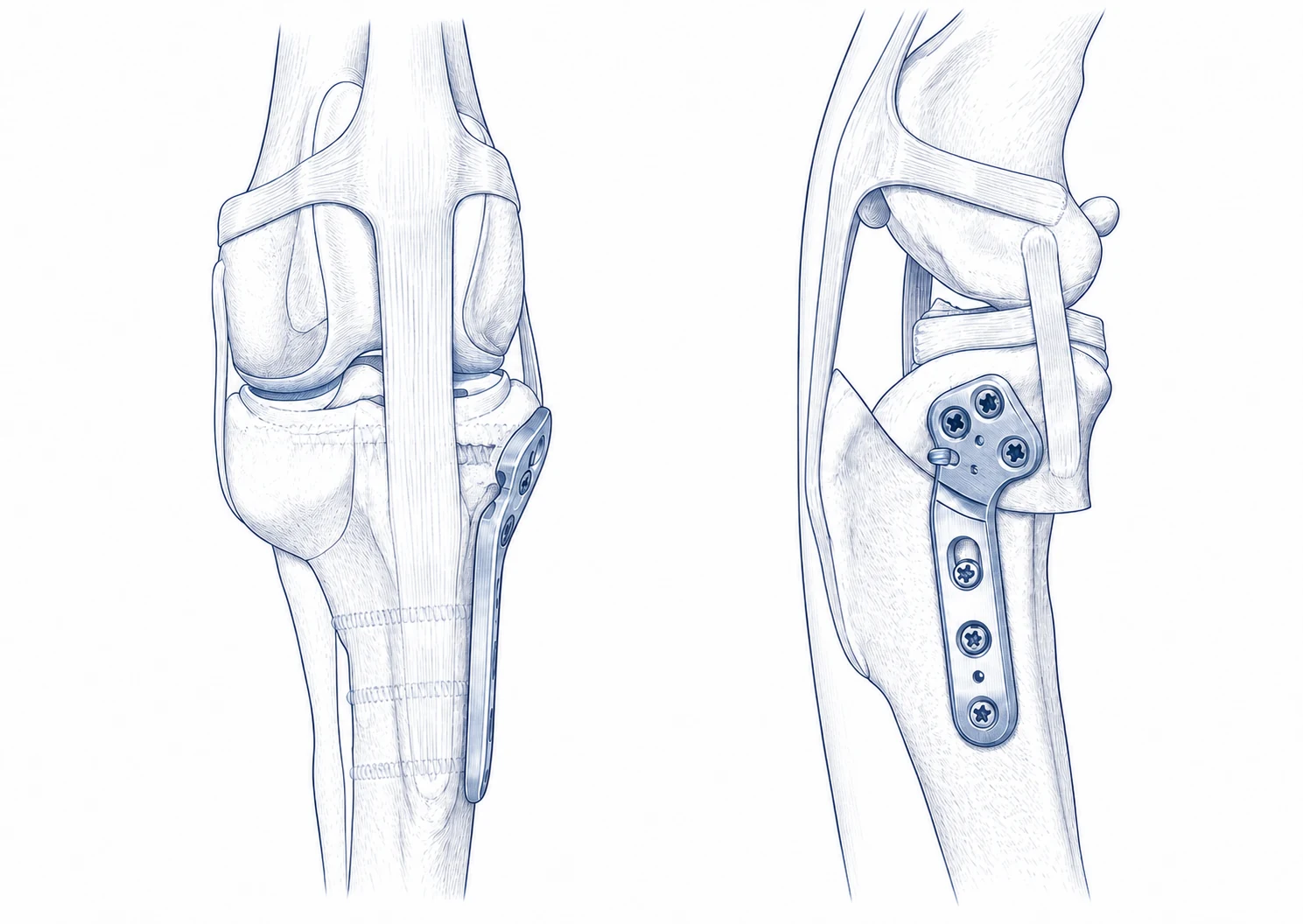
The planned cut in the upper shin bone needs time to heal around the plate and screws. A fall, jump, too much activity, or slow bone healing can put the repair at risk. New severe limping, pain, swelling, or a sudden setback should be checked.
An exam and X-rays show whether the bone, plate, and screws are still in the expected place. Activity should not increase just because a dog seems comfortable. Bone healing must also be confirmed.
Preserving the meniscus and later tears
During every TPLO, I inspect the meniscus through a small opening in the knee called a mini-arthrotomy. I preserve it unless there is a displaced bucket-handle tear that is likely causing pain. When that tear is present, only the damaged portion is removed.
When the meniscus is preserved, the final rotation is informed by two types of evidence. A seven-limb pressure-mapping study found less force on both menisci when TPLO ended near 1 degree rather than 6 degrees. In a clinical study of 236 knees, each 1-degree higher postoperative angle was associated with higher odds of later limping and later meniscal surgery. Together, these findings support aiming for a slightly lower final angle when appropriate, but they do not prove that one angle prevents every later tear.
In that 236-knee study, 37 knees developed later limping. Twenty-four improved without meniscus surgery, while 13 knees (5.5%) later needed it. The first surgery in that study did not include the same routine meniscus inspection used in my TPLOs, so the results provide context rather than a forecast for my patients.
Later limping has many possible causes. It does not prove that the meniscus has torn or that another operation is needed. See the meniscus explanation and pressure maps.
Plate or screw irritation
The plate and screws most often stay in place after the bone has healed. They are not removed as a routine step. Removal may be discussed for a confirmed infection, irritation, or another problem linked to the plate or screws.
X-rays taken after surgery are checked for plate and screw position. If a screw may extend into the joint and the X-rays are unclear, other views or scans may be used before deciding whether another operation is needed.
Ongoing stiffness or worsening arthritis
TPLO changes how a knee works after a cruciate tear. It does not remove arthritis that was already there. Some dogs stay stiff or need long-term help with weight, exercise, rehab, or arthritis care.
Fish-oil omega-3s containing EPA and DHA may be one part of an arthritis plan. Studies in dogs have found improvement in some mobility measures, but fish oil does not reverse arthritis or replace weight control, rehab, or prescribed pain care. Use it only when recommended, and use the EPA + DHA amounts rather than the total fish-oil amount. Open the EPA + DHA calculator.
Ongoing or worse limping should not simply be blamed on arthritis without a new check. This is most important when the pattern changes after a period of improvement.
The opposite knee: important, but not caused by TPLO
Cruciate disease often gets worse over time and can affect both knees. It is not caused by TPLO.
later tore the ligament in the other knee. The median time was 947 days, or about 2 years and 7 months.
later had a tear in the other knee. The median time was 12.9 months in this 831-dog study.
These studies followed different groups. Their results should not be treated as one rate for all dogs. In the older group, risk fell as age at the first diagnosis rose. A new limp in the other hind leg should be checked as a new problem.
Sources used for this guide
- American College of Veterinary Surgeons: Cranial Cruciate Ligament Disease
- Mans et al.: small skin openings after TPLO incision closure
- Glenn et al.: owner questionnaire for active surgical-site infection surveillance
- McDougall et al.: deep surgical-site infection requiring TPLO implant removal
- Savicky et al.: outcome after removal of infected TPLO implants
- Philips et al.: radiographic assessment of possible intra-articular TPLO screws
- Schmutterer et al.: meniscal load after TPLO ending near 6 degrees and 1 degree
- Treharne et al.: late lameness and meniscal treatment after proximal tibial osteotomy
- COAST Development Group: international canine osteoarthritis treatment guidelines
- Roush et al.: fish-oil omega-3 diet and mobility measures in dogs with osteoarthritis
- Muir et al.: contralateral cruciate survival after unilateral rupture
- Murphy et al.: contralateral rupture in older medium-to-large dogs